


 Back to Blogs
Five critical insights from HR Tech Europe 2026 that redefine HR transformation
HR Tech Europe 2026 in Amsterdam brought together over 2,400 senior HR leaders to examine how enterprise AI is fundamentally reshaping workforce management. From Josh Bersin's analysis of AI evolution to vendor demonstrations of agent architectures, the event revealed a market in transition from personal productivity tools to systemic HR transformation.
Elliot Raba
14.05.2026 · 8 min read


The challenge facing organisations is no longer selecting the right technology platform but building the operational infrastructure to deliver sustained value from AI-enabled HR systems across complex European operations.
The defining moment for enterprise AI in HR
HR Tech Europe 2026 took place at a pivotal juncture in the evolution of enterprise technology. The event made clear that 2025 and 2026 will be remembered as the period when AI moved from novelty and personal assistant to genuine enterprise HR transformation tool. Much like the early days of internet adoption or cloud migration, the current moment combines confusion, rapid change, and foundational shifts that will define HR operations for the next decade.
Josh Bersin's keynote addressed this transition directly, outlining how AI has progressed through distinct phases from novelty in 2022 to assistant capabilities in 2023-24, then to agent functionality in 2024-25, and now toward superagent platforms designed for enterprise-wide automation. The uncertainty many HR leaders feel is not a sign of poor planning but a natural response to simultaneous redefinition of tools, processes, and organisational structures.
The exhibition floor reflected this evolution. SAP demonstrated SuccessFactors with Business AI capabilities serving over 140 million users across 13,000 customers, with 825 new go-lives in the first half of the year alone. Oracle showcased AI agents for Fusion Applications designed to drive efficiency and growth through generative AI-powered services embedded into business processes. These were not experimental features but production capabilities reshaping how enterprises approach talent acquisition, performance management, and workforce planning.
Enterprise AI differs fundamentally from personal productivity
One of the event's clearest themes was the distinction between personal AI use and enterprise AI deployment. Employees already use powerful AI tools privately and expect similar capability at work. However, enterprise AI operates under entirely different constraints. It must integrate with existing systems accumulated over 20 to 25 years. It must respect data governance frameworks spanning multiple jurisdictions. It must operate across workflows rather than isolated point solutions.
Most organisations remain far behind employee expectations in this dimension. The challenge is not acquiring new AI tools but transforming legacy HR technology, business rules, and data architectures to support AI-enhanced processes. This is why the event's conversations frequently returned to integration and HR transformation rather than tool selection. Buying impressive technology is straightforward. Making it function within existing operational complexity is where most initiatives encounter friction.
This insight connects directly to operational delivery models. Technology platforms can provide sophisticated AI capability, but organisations still require implementation expertise to deploy those platforms and managed services to operate them continuously across diverse regulatory environments. The execution gap between impressive demonstrations and daily operational reality remains the primary obstacle to HR transformation success.
AI agents and superagents reshape operational architecture
Multiple sessions explored the emerging architecture of AI agents and superagents. The progression moves from AI assistants that support tasks to AI agents that execute tasks, then to multi-agent systems that handle end-to-end processes, and ultimately to superagents that coordinate across functions. Presentations illustrated how onboarding processes that traditionally required six to nine months of major IT project work now operate through superagent orchestration managing dozens of individual agent activities across pre-hire, laptop issuance, IT credentials, building access, benefits enrolment, time and attendance setup, and compliance requirements.
The implications for HR operations are substantial. Skills intelligence can be automated through AI that infers capabilities from profiles and data, benchmarks against competitors, and identifies gaps instantly. Talent acquisition integrates AI across recruitment workflows rather than deploying isolated chatbots. Learning & Development shifts from structured courses to real-time, AI-generated contextual enablement embedded directly into work.
However, the market currently faces significant fragmentation challenges. Agent sprawl creates proliferation of tools with poor integration. Standards remain immature. Governance models are still evolving. Enterprise architectures capable of managing dozens or hundreds of agents across HR, finance, sales, and operations do not yet exist in most organisations. Close alignment between HR and IT becomes critical to navigate this transition successfully.
Platform consolidation over point solution proliferation
A recurring observation from booth conversations and session discussions was the shift away from best-of-breed point solutions toward integrated platforms. This trend appears strongest in talent acquisition, where organisations already struggle with excessive vendor relationships. The future direction points toward end-to-end integrated AI systems rather than continued accumulation of narrow tools requiring constant integration maintenance.
This consolidation impulse reflects hard-won lessons from previous technology cycles. When corporate applications increased 57% to 1,057 tools in just three years according to data presented at the event, with HR and productivity applications representing the fastest-growing segment, coordination overhead escalates faster than capability gains. Each additional vendor brings separate contracts, distinct integration requirements, and fragmented accountability when issues span multiple systems.
The kitchen drawer problem, as Bersin termed it, creates environments where nobody can find anything despite having dozens of specialised tools. Integration beats narrow optimisation when the goal is sustaining operational performance rather than isolated efficiency gains. Organisations seeking to deploy AI across HR operations benefit more from unified platforms where data flows seamlessly than from assembling best-in-class components that resist coordination.
The operational challenge of lifecycle accountability
Walking the HR Tech Europe exhibition floor revealed an interesting pattern. Technology platform vendors demonstrated impressive capabilities. Implementation specialists showcased deployment methodologies. BPO providers highlighted service delivery scale. Each category excelled within its domain. The challenge emerges when organisations attempt to coordinate these fragmented relationships into coherent operational delivery.
When AI-enhanced onboarding encounters issues six months after implementation, which vendor resolves the problem? The platform provider who built the underlying system? The implementation partner who configured the workflows? The managed service provider who operates daily processes? The AI agent vendor who supplied the orchestration layer? This accountability ambiguity is precisely what causes HR transformations to underdeliver despite appropriate technology selection.
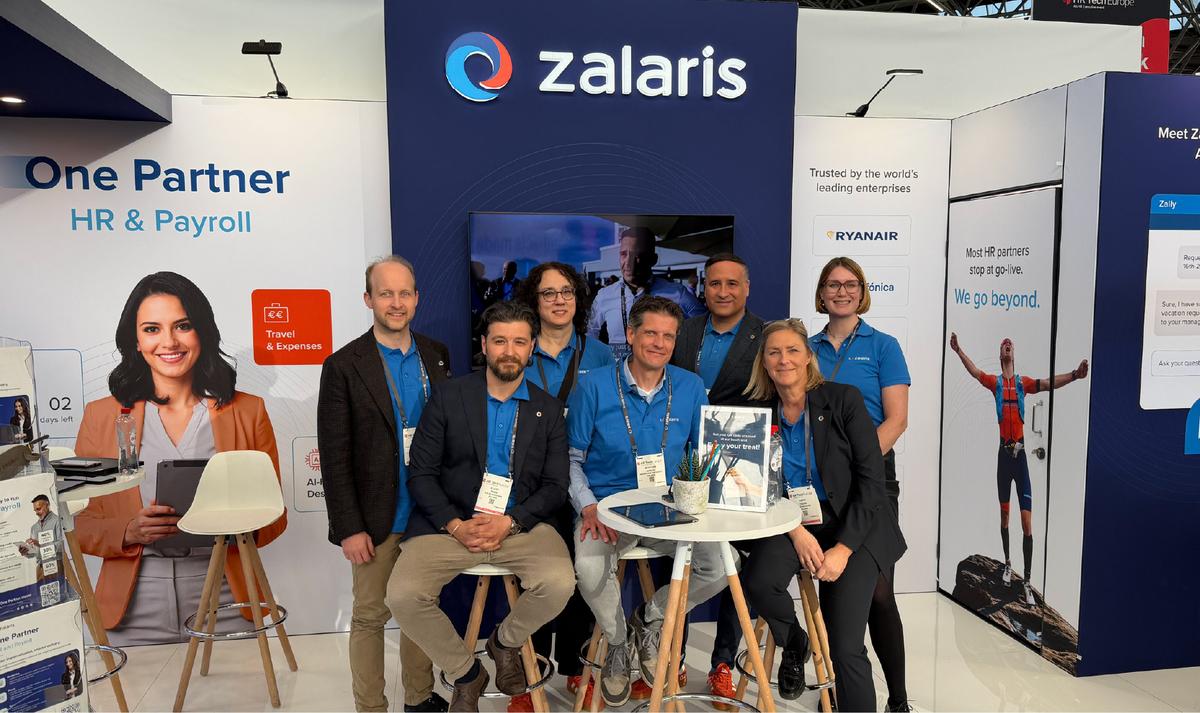
The conversations at Zalaris’ booth at the event consistently surfaced this execution gap. Organisations invest heavily in platform evaluation and implementation planning. Operational planning for the decade after go-live receives far less attention until coordination challenges become apparent. Payroll accuracy issues stemming from system configuration rather than transaction processing expose the boundary between technology capability and operational delivery. Regulatory changes requiring system updates across multiple markets reveal whether partnerships scale or fragment as complexity increases.
Unified partnership models address this gap through complete lifecycle accountability. When implementation teams, payroll processors, compliance specialists, and AI deployment experts operate within the same organisation under unified platform architecture, data flows seamlessly, governance simplifies, and responsibility remains clear. This operational continuity matters more as AI agents proliferate, and superagent architectures emerge, because coordinating dozens of intelligent agents across fragmented vendor relationships multiplies rather than reducing complexity.
What this means for HR transformation strategy
HR Tech Europe 2026 made clear that successful transformation requires rethinking both technology architecture and partnership models.
The right question is not "what is our AI strategy?" but rather "what business outcomes are we trying to achieve and how does AI enable them?"
Technology serves business goals rather than becoming the objective itself. For organisations planning HR transformations, several imperatives emerged from the event.
First, AI deployment must start with business objectives rather than technology enthusiasm. Return on investment, measurable outcomes, and value creation to determine success, not the adoption of impressive tools.
Second, integration and transformation matter more than tool selection. Organisations cannot simply buy new AI capabilities. They must reengineer 20 to 25 years of accumulated HR technology, data, and processes to support AI-enhanced operations.
Third, partnership structure determines execution success. Coordinating separate vendors for technology platforms, implementation services, managed operations, and AI deployment creates the accountability gaps that cause transformations to plateau after go-live. Unified partnerships that maintain responsibility from implementation through ongoing operations across all European markets eliminate coordination overhead and clarify governance.
Fourth, the superworker era demands operational excellence alongside technological capability. AI will augment human performance rather than replace workers wholesale. This creates opportunities for more meaningful work, higher productivity, and new roles. However, realising this potential requires operational infrastructure that delivers reliable systems, compliant processes, and continuous optimisation as business requirements evolve.
The event demonstrated that enterprise AI transformation is well underway. The question for HR leaders is whether their organisations are prepared not just to select impressive technology but to operate it successfully across the complex, regulated, multi-country environments that characterise European business. The winners will be those who recognise that HR transformation success depends as much on operational partnership as technological capability.
The one partner advantage in an AI-enabled future
As AI agents and superagents reshape HR operations, the execution gap between technology capability and operational delivery becomes more critical, not less. Unified partnership models that combine platform implementation with managed services under single accountability frameworks eliminate the coordination overhead that fragments traditional vendor relationships.
When implementation teams who configure AI-enhanced onboarding workflows also operate payroll processing and manage compliance across 20 European markets, agent architectures function seamlessly because all capabilities exist within unified platform environments. Data flows without integration middleware. Governance remains clear when issues emerge. Accountability does not fragment across vendor boundaries.
This operational continuity enables organisations to focus internal HR capacity on workforce strategy rather than vendor coordination. Strategic capability remains in-house. Transactional complexity, including AI agent deployment and superagent orchestration, becomes the responsibility of partners who maintain lifecycle accountability from modernisation through daily operations.
Explore how the One Partner model delivers technology implementation and ongoing managed services under unified accountability here.

Elliot Raba
Enterprise Sales Executive
Elliot is a dynamic and results-driven Enterprise Sales Executive at Zalaris UK&I, where he excels in crafting innovative solutions that address the unique needs of his clients. With a keen understanding of the intricacies of enterprise level operations, Elliot leverages his extensive industry knowledge to drive business growth and foster lasting partnerships.