
Performance management has become a critical driver of organisational success, enabling more transparency, stronger alignment, and more meaningful performance and development conversations. McKinsey research revealed organisations that focus on their people’s performance alongside effective performance management processes are 4.2 times more likely to outperform their peers, realise an average 30% higher revenue growth and experience 5% lower attrition.
For many organisations, SAP SuccessFactors Performance & Goals is a key enabler of performance management and organisational success. But realising these benefits depends not simply on deploying the technology, but on how it is designed, governed, and adopted across the business. A successful P&G implementation is one that:
- Employees understand intuitively
- Supports managers in initiating and structuring performance conversations and
- Leadership can rely on to drive transparency and alignment at scale.
Rather than pursuing complexity through extensive customisation, high-impact implementations are shaped by a focus on simplicity, consistency, and best-practice design. When processes are clear and governance is thoughtfully embedded from the outset, Performance & Goals becomes more than a system - it becomes a practical foundation for ongoing feedback and measurable goals.
Why Performance & Goals implementations often fall short
Performance management sits at the heart of organisational effectiveness, yet many Performance & Goals (P&G) initiatives fail to deliver the behavioral and business outcomes they promise. While organisations increasingly recognise the strategic importance of performance management, execution often falters. This is not because of the technology itself, but because of how performance frameworks are designed, governed, and experienced by the people expected to use them.
McKinsey’s research on modern performance management highlights that traditional and poorly implemented approaches frequently fail to improve engagement, productivity, or development outcomes. Systems that emphasise processes, forms, and administrative compliance over constructive feedback and strengths-based development rarely achieve their intended impact.

Over-engineering: when complexity undermines adoption
One of the most common causes of underperformance in P&G implementations is excessive complexity. In an effort to meet every local requirement, stakeholder preference, and policy nuance, performance management software can become cumbersome.
Systems that are difficult to navigate or overly tailored to specific use cases can reduce user engagement and slow adoption. Simplified solutions, by contrast, tend to be easier to use and maintain.
Misalignment between technology and business objectives
A recent Gartner survey found that only 24% of HR functions say their organisation is deriving the maximum value from HR technology, and just 35% are confident that their current approach to technology supports business objectives. This gap between investment and impact suggests that many HR technology implementations struggle to align with what managers and employees need to drive performance outcomes.
This disconnect often stems from focusing too much on administrative workflows and reporting features, and not enough on how people actually use the system to set goals, receive feedback, and develop skills.
Fragmented governance in multi-country environments
The challenge is amplified in organisations operating across regions and countries. To accommodate local requirements, governance structures are frequently decentralised or modified on a market-by-market basis. While this can appear pragmatic, it often leads to fragmented ownership, inconsistent processes, and unclear accountability for how performance is defined, measured, and evaluated.
McKinsey’s research on performance management identifies fragmentation and inconsistency as recurring challenges in performance systems, with organisations needing clearer design choices that reflect both global strategy and local context.
The hidden risk: designing for processes instead of people
Another common shortfall is designing performance systems around internal process structures rather than the actual work experience of managers and employees. Many programmes prioritise ratings, workflows, or governance checklists at the expense of clarity, usability, and the quality of performance conversations. When users find the system confusing or burdensome, tracking progress becomes transactional and behavior change remains limited.
When implementation does not equal impact
When complexity, fragmented governance, and low usability converge, organisations are often left with performance frameworks that are technically implemented but operationally ineffective. The system exists, but it does not meaningfully shape behaviour, decision-making, or development. Continuous improvement and cross-functional collaboration remain stalled.
These challenges are not the result of flawed ambition. They stem from design choices. How much complexity is introduced, how governance is structured, and whether the system is built for real-world use all play a decisive role. Performance & Goals initiatives do not fail because organisations aim too high. They fall short when execution prioritises structure over simplicity and processes over people.
How Yunex Traffic approached Performance and Goals management differently
Yunex Traffic faced many of the challenges that typically hinder P&G implementations. The organisation needed a solution that was both globally consistent and locally adoptable. The goal was simple: create a Performance & Goals system that employees and managers actually use. Simplicity was a key design priority while maintaining transparency, alignment, and efficiency across markets.
We spoke with Dr. Kirsten Weerda, Chief People Officer at Yunex Traffic, about their recent SAP SuccessFactors Performance & Goals implementation. Dr. Weerda shares how disciplined design, a focus on usability, clear governance, change management, and involving key business stakeholders shaped a Performance & Goals framework that people actually use.

Q: Yunex operates across 24 countries with 3,500 employees. What prompted the decision to rethink Performance & Goals?
Kirsten Weerda: Like many companies in the last few years, we decided to move away from our former cumbersome and complex yearly performance management process, towards a very flexible, non-formalised Growth Talk. The idea was to limit bureaucracy and trigger continuous feedback. Unfortunately, this did not really work out, and over time our well-intentioned idea of simplicity led to a reality where reviews were often incomplete, and we lost transparency of our key talents globally.
To reenergise effective developmental conversations with our employees and establish a global, consistent and transparent performance management system, we implemented a new development and performance management system, Our ambition was to build a formal global system and process that is still simple, easy to use and can support our leaders in having effective development and performance conversations with their employees.
But doing that manually at scale simply wasn’t sustainable. We needed a global standard for setting expectations in the form of goals, evaluating performance, establishing a transparent basis for developmental conversations and creating consistency across markets, without making the system heavy or bureaucratic.
Q: Many global organisations struggle with complexity in Performance & Goals implementations. How did Yunex approach this?
Weerda: From the start, we were very clear that simplicity had to guide the design. Throughout the implementation process, we always challenged ourselves to make the process as simple and easy to use as it could be. We deliberately avoided excessive customisation and aligned closely with SAP SuccessFactors best practices for goal management, performance cycles and calibration.
The standard system still allowed us to simplify all steps in the process as much as possible. That gave us a standardised framework that people could actually understand and use. Our goal was not to accommodate every local preference, but to create something intuitive that works across countries.
Q: Governance is often where multi-country projects become fragmented. How did you manage this?
Weerda: Governance was built into the project from day one. We involved stakeholders from all participating regions in testing and alignment, which meant we heard different perspectives early. Importantly, we agreed on global standards.
We also installed a ‘sounding board’ with members from different locations and areas of the business. The sounding board helped us challenge our solution, and test usability throughout the process. That broad involvement but still clarity of ownership and decision-making in the small implementation team helped us avoid inconsistencies and ensured that goals are captured and performance is defined and evaluated in the same way across markets.
Q: Adoption is another common stumbling block. What did Yunex do to ensure people actually use the system?
Weerda: Since we are still at the beginning stage, I don’t want to celebrate high adoption too early.
But we had adoption always in mind throughout the design and implementation process. We focussed on 3 key elements to ensure adoption:
- We involved the business side, especially the leadership team, closely in the design phase aligned on our objectives and choices when defining the system and process. For example, we discussed how to strengthen the developmental aspect of the system while still basing ratings on individual performance against set expectations/goals. We also invited regional people partners to contribute to discussions over design choices, and during testing and implementation.
- We included our change management and capability-building experts throughout the design and implementation phase. This helped us stay prepared for adoption measures early on – including continuous communication throughout the implementation process, beta-testing the new system with different stakeholder groups and preparing internal training initiatives such as drop-in sessions.
- The effective conversations between leaders and employees were at the heart of our process design. To ensure the message flows smoothly, we launched a global leadership training program that guided managers on not only the system, but also strategies to set meaningful goals and give constructive feedback. This allowed us to practice the actual conversations, while highlighting how the process and system helps us achieve our organisational goals – using the same language across the globe.
Q: The project was delivered in just seven months. What enabled that level of discipline?
Weerda: We followed a structured methodology and maintained very close project follow-up on both sides. There was clear accountability and we were fully aligned on goals such as simplicity. This helped us resist scope creep, and our focus allowed us to stick to the timeline and go live on November 19th without delays.
Q: What has changed since go-live?
Weerda: We are already seeing the first stage of improvements that are a direct consequence of development conversations, transparency and goal alignment across countries. Managers are having more consistent conversations about expectations and defining them in ‘what’ and ‘how’ goals. This is an excellent basis for an improved, long-term, talent development process. I personally love that I have an easy way to capture goals with my employees in a user-friendly system, and I use these goals in my regular 1:1s to see if we are focusing on the right topics and provide support where my employees might need it.
Q: What would you say to other organisations embarking on a Performance & Goals transformation?
Weerda: While technology is a great enabler to create impact, the key is to work with leaders and employees on having effective development conversations. To enable an efficient and timely implementation, strong design principles such as simplicity, clearly defined and aligned design choices, robust governance, and the involvement of key business stakeholders are essential.
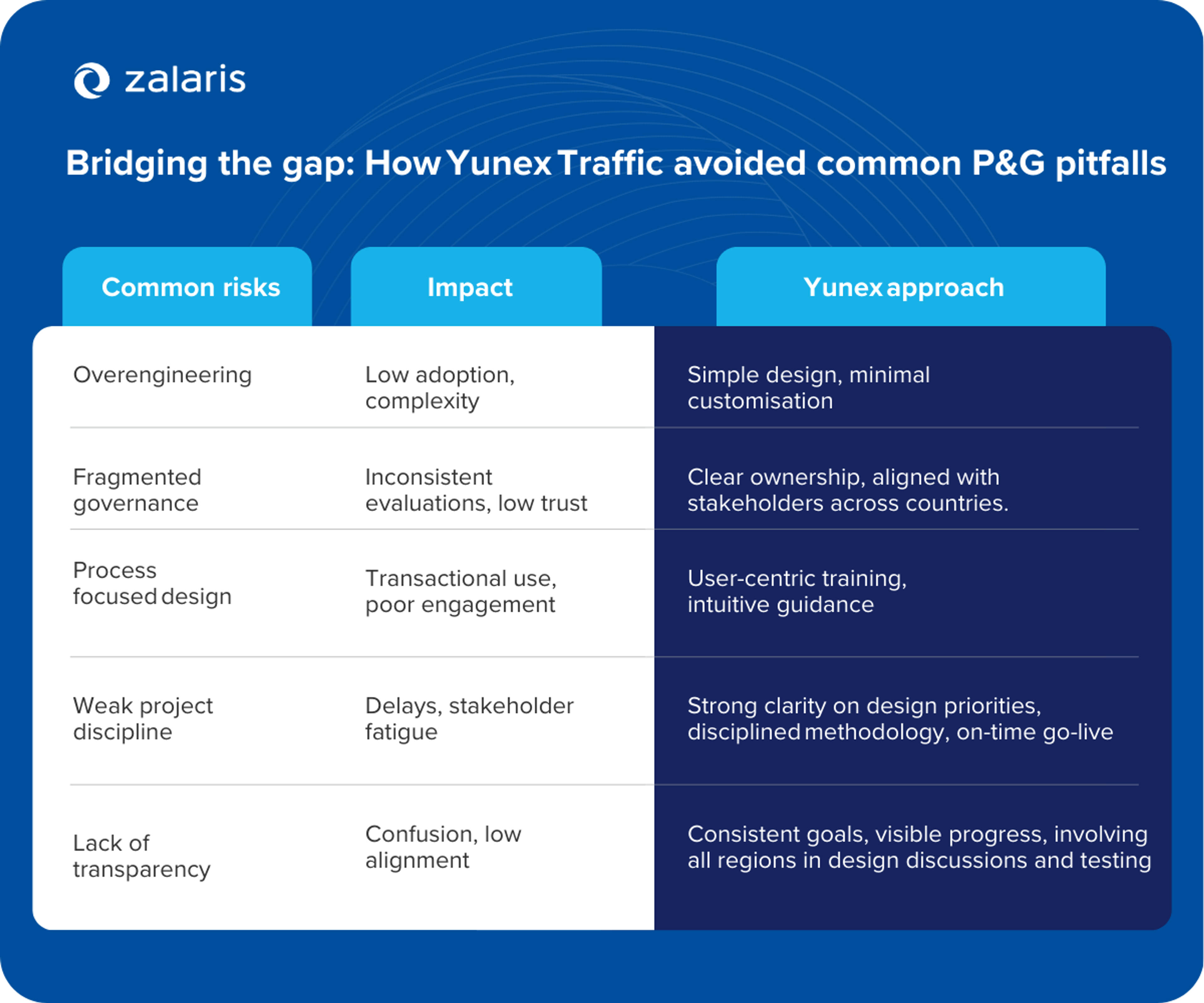
Driving performance forward
Yunex Traffic’s experience demonstrates that high-impact Performance & Goals implementations are not about complexity or extensive customisation. Success comes from clear design, disciplined governance, and a strong focus on the people using the system every day.
By leveraging SAP SuccessFactors best practices and pre-configured guidance, this project demonstrates how thoughtful design choices, coupled with timely delivery and user-centric adoption, can turn a technology rollout into a practical foundation for organisational performance.
If your organisation is embarking on a P&G transformation, Zalaris’ 25+ years of expertise in guiding organisations through SAP SuccessFactors implementations ensures you go live on time while achieving meaningful adoption and measurable business impact across global teams. Get in touch with our experts today!