The goal of most HR transformation projects is straightforward: reduce manual work, improve compliance and give leaders reliable people insights. However, many organisations today are finding that their HR technology investments are not yielding the ROI they expected. Recent research underscores the scale of the problem. Only 24% of HR leaders report they are deriving maximum business value from HR technology. McKinsey’s analysis shows that as many as 70% of transformation programmes fail to deliver the intended outcomes, and the primary causes are organisational and behavioural rather than technical.
These are not academic findings. They describe what HR teams see in practice: a great system that still fails to change how work is done, or dashboards that leaders do not trust. When transformation focuses on technology alone, organisations routinely miss the harder work of process, people and governance.
The value gap in HR technology: HR functions vs HR strategy
Conversations with HR leaders reveal recurring patterns: They select a market-leading platform, but processes are simply migrated into the new system unchanged. They train users on functionality but not on new ways of working. They deliver a technically stable go-live, and assume adoption will follow.
Industry analysts and HR researchers have repeatedly shown that poor adoption and limited change management are major barriers to realising value from HR technology. For example, HR practitioners have reported high rates of implementation difficulties where data quality, integrations and adoption were not treated as central deliverables.
Fragmented vendor models also create problems. When implementation, payroll, employee support, and analytics are handled by separate parties, accountability blurs the moment things go wrong. Hand-offs slow down and user experience suffers, increasing the risk of operational failure and reducing the ability to deliver results efficiently. This fragmentation can lead to higher costs and challenges in accessing actionable insights from HR data, hampering the organisation's ability to make informed decisions aligned with business strategy.
Finally, reconciliation remains a material operational effort for many teams. Payroll and HR teams often spend significant time reconciling data or resolving exceptions after a go-live.
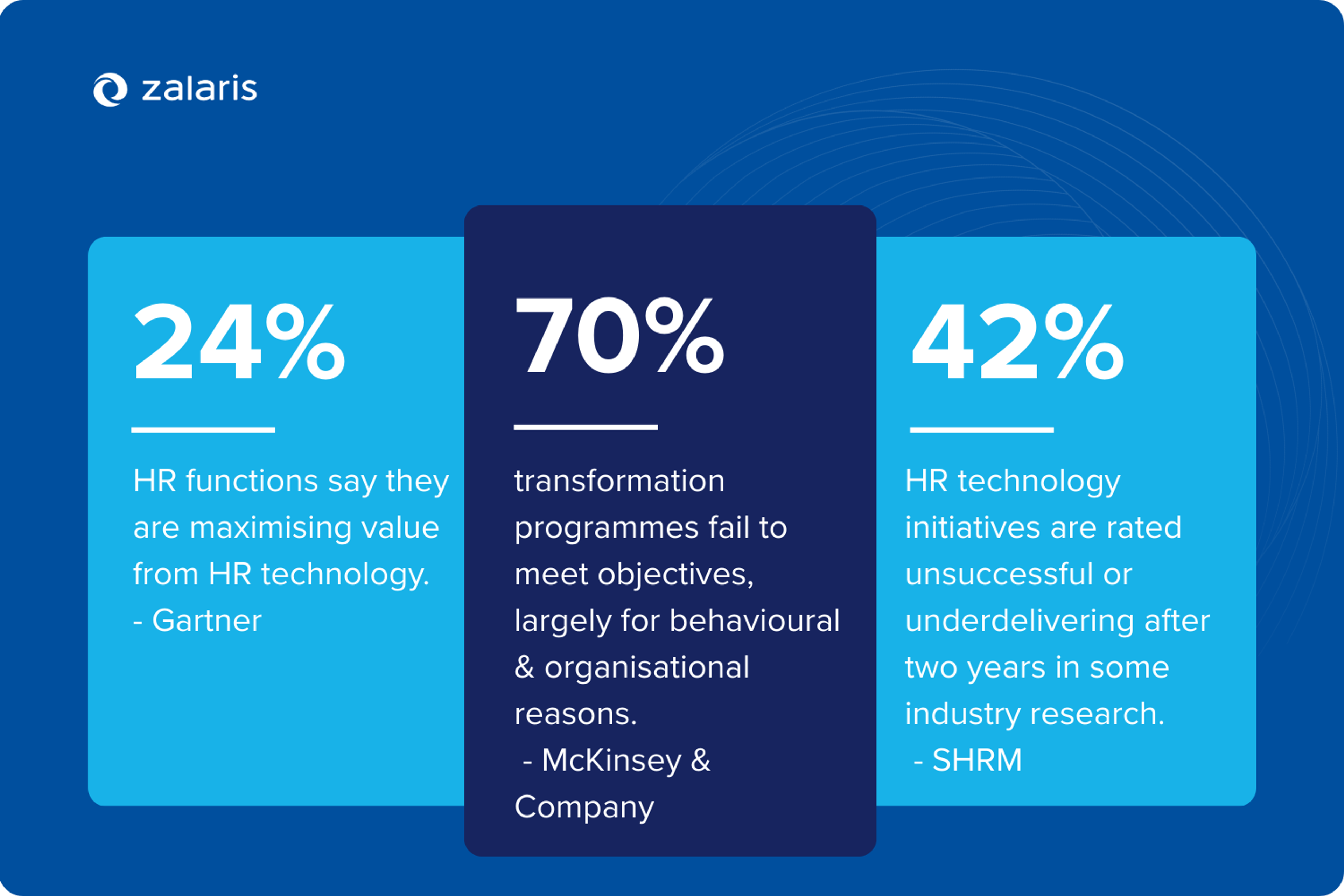
Source: 1. Gartner 2. McKinsey & Company 3. SHRM
Best practices that deliver results
Organisations that get it right treat HR transformation as a continuing operating model change, not a one-off project. The most reliable programmes combine four elements.
- Clarity of outcome
Decide the business and talent outcomes first. If you cannot justify how a capability will improve a specific metric, rethink it. - End-to-end process design
Redesign processes before you configure the system. Simple workflows and fewer hand-offs reduce error and speed adoption. - Sustained change leadership
Invest in change activity that continues after go-live. Adoption improves when managers remain engaged and support is visible and ongoing. - Operational ownership
Assign clear accountability for operations, data quality and integration. When one partner or a single accountable team manages these areas, issues get fixed faster and value is preserved.
These principles are supported by the industry evidence. McKinsey researchers revealed that success correlates strongly with active leadership involvement, disciplined execution, and continuous capability building within HR teams. This means that HR leaders and professionals must not only focus on implementing new HR technology but also on evolving HR processes and operations to fully leverage the potential of digital tools. By integrating data-driven insights and fostering a culture of innovation, organisations can better align their HR strategy with broader business goals and rapidly changing employee expectations.
Continuous training and development are essential to equip HR teams with the skills needed to manage administrative tasks efficiently while delivering expert advice and trusted guidance to the C-suite and managers. Ultimately, this holistic approach to HR transformation drives operational efficiency, enhances the employee lifecycle, and supports sustainable business growth in an environment of rapid change and increasing complexity.
Why organisations are choosing One Partner
To reduce fragmentation and sustain value, many organisations now prefer a single, accountable partner who can both deliver and operate their HR systems. This approach significantly simplifies governance structures, making it easier to manage service level agreements (SLAs) and ensuring clearer accountability.
Having One Partner responsible for end-to-end delivery allows businesses to prioritise enhancements that truly matter to their organisational goals and workforce needs. It also helps streamline communication, reduce delays caused by multiple vendors, and improve the overall employee experience by providing consistent support and expertise.
Ultimately, partnering with a single provider supports operational efficiency and helps HR functions stay ahead in a rapidly changing business environment, fostering greater productivity and better alignment with broader business strategy.

Planning on implementing or optimising HR technology? Avoid these 8 common mistakes
If you are evaluating vendors, preparing for a HR system go-live or trying to get more from an existing system, read our paper on the 8 costly mistakes to avoid in HR transformation, and access practical guidance based on real-world projects. It covers the governance, change and operational steps that protect value after go-live.
Download the whitepaper now to get a full checklist and execution playbook! Enter your details to receive a free copy.

Tuomo Ropponen
Vice President Account Management,
Organisations continue to invest heavily in cloud HR transformation, modern payroll processing and people analytics. Yet, many struggle to realise the value they set out to achieve. Tuomo Ropponen explores the 8 costly mistakes to avoid in HR transformation and provides practical guidance based on real-world projects and 25+ years of HR tech experience