Back to Resource Library
Transforming HR through data: An essential guide to HR Reporting and Analytics
Workforce data is only valuable when it informs action. HR analytics and reporting give organisations the visibility needed to improve performance, anticipate talent needs, and support better decisions.
Zalaris
08.02.2026·7 min read



Modern organisations are no longer debating whether data belongs in HR. The real question is how effectively the human resources department can turn vast volumes of workforce data into meaningful action. HR analytics and reporting have evolved from operational tools into strategic capabilities that influence business performance, guide leadership decisions, and help companies thrive in competitive markets.
For HR professionals, the shift toward data-driven HR represents an opportunity to elevate the function from administrative support to strategic partner. When employee data is collected thoughtfully and analysed using advanced analytics tools, it reveals patterns that help business leaders address business problems before they escalate, strengthen employee engagement, and align HR initiatives with business goals.
This guide explores how organisations can use HR data analytics to unlock valuable insights, improve employee satisfaction, and support evidence-based decisions across the entire organisation.
Why HR analytics and reporting matter more than ever
Every organisation generates enormous amounts of people data. From recruitment and onboarding to development programs and succession planning, each HR process creates data points that, when analysed correctly, provide a clear view of workforce trends.
Yet many HR teams still struggle with fragmented HR systems, inconsistent data collection practices, and unreliable data sources. Without accurate data, even the most sophisticated analytics activity cannot deliver meaningful results.
Human resources reporting brings structure to this complexity. By transforming raw data into reliable data sets, HR reporting allows teams to monitor key metrics such as turnover rate, employee productivity, acceptance rate, and performance metrics. These insights support strategic decisions that affect not just the HR function but the entire business.
Organisations that prioritise reporting and analytics gain a strategic advantage. They are better equipped to anticipate future hiring needs, refine the recruitment process, and ensure leadership positions are filled with the right talent at the right time.
Understanding the foundations of HR data analytics
At its core, HR data analytics is about analysing people data to uncover performance patterns and opportunities for improvement. However, effective analytics begins long before dashboards and visualisations appear.
Data collection with purpose
Successful organisations collect data intentionally rather than accumulating information without direction. This means identifying relevant data tied directly to business objectives. For example, if improving customer satisfaction is a priority, HR teams might focus on employee engagement scores, training participation, and employee performance data.
Ensuring data quality
Valuable data must also be accurate data. Inconsistent performance data or incomplete employee satisfaction surveys can distort HR analytics findings and lead to poor business decisions. Dedicated HR software plays a crucial role here by standardising data collection and maintaining a single source of truth.
Connecting data across systems
When workforce data lives in disconnected platforms, HR professionals spend more time reconciling spreadsheets than generating actionable insights. Integrated HR systems help collect data seamlessly across the hiring process, talent acquisition workflows, and employee lifecycle events.
The result is a comprehensive view that allows HR teams to gain insights quickly and respond with confidence.
Three levels of analytics every HR team should use
Not all analytics deliver the same value. Mature analytics and reporting strategies typically progress through three stages, each deepening organisational understanding.
Descriptive analytics: Understanding what happened
Descriptive analytics summarises historical HR metrics. It answers straightforward questions such as:
- What is our average age across departments?
- Which teams show high engagement scores?
- How has our turnover rate changed over time?
Although descriptive analytics looks backward, it provides essential context for interpreting workforce trends.
Predictive analytics: Anticipating what comes next
Predictive HR analytics uses statistical modelling and performance patterns to forecast outcomes. Instead of reacting to attrition after it occurs, HR teams can identify employees who may be at risk of leaving and intervene early.
Predictive analytics is especially valuable in talent acquisition. By examining acceptance rate trends, sourcing channels, and job ad performance, organisations can refine the hiring process and prepare for future hiring needs.
Prescriptive analytics: Guiding strategic action
Prescriptive analytics goes one step further by recommending actions based on data analysis. For example, if analytics findings show that employees feel more engaged after participating in development programs, HR can scale those initiatives to improve employee satisfaction across the workforce.
Together, these capabilities enable HR professionals to move from observation to strategic execution.

Turning employee data into business value
Data-driven HR is not about dashboards for their own sake. The ultimate objective is stronger business success.
When HR analytics is embedded into everyday decision-making, organisations begin to see measurable improvements:
Better employee productivity
Performance metrics reveal where employees excel and where additional support is needed. Line managers can use these insights to provide targeted coaching and allocate resources effectively.
Stronger employee engagement
By examining employee satisfaction alongside performance data, HR teams can identify factors that contribute to high engagement scores and replicate them across departments.
More effective succession planning
Analytics helps organisations spot emerging talent early, ensuring leadership positions are supported by a robust pipeline.
Improved talent acquisition
Data analysis highlights bottlenecks in the recruitment process, whether they occur during screening, interviews, or offer stages.
Alignment with business goals
When HR metrics connect directly to business objectives, the function becomes a driver of strategic advantage rather than a reporting centre.
Overcoming common challenges in HR analytics
Despite its benefits, implementing HR analytics and reporting is not without obstacles.
Breaking down data silos
Many organisations still rely on separate tools for payroll, performance management, and recruitment. Consolidating these sources into dedicated HR software ensures reliable data flows throughout the analytics ecosystem.
Building analytical capability
Advanced analytics requires both technology and skills. HR professionals must feel confident interpreting analytics findings and communicating them to business leaders in a way that informs strategic decisions.
Protecting employee data
As organisations collect data at scale, safeguarding employee data becomes critical. Strong governance ensures that valuable insights are generated responsibly while maintaining trust.
Focusing on relevant metrics
More data does not automatically translate into better outcomes. The most effective HR teams prioritise key metrics that directly impact business performance rather than tracking every available data point.
Creating a truly data-driven HR function
Transitioning to data-driven HR is as much about mindset as it is about technology.
Start by aligning analytics activity with clear business problems. Are you trying to reduce attrition? Improve employee engagement? Strengthen the hiring process? Defining the objective ensures analytics efforts remain purposeful.
Next, empower line managers with accessible reporting and analytics tools. When decision-makers across the entire organisation can interpret performance data, evidence-based decisions become the norm rather than the exception.
Finally, treat analytics as an ongoing capability rather than a one-time project. Workforce trends evolve constantly, and HR systems must adapt accordingly.
Organisations that embrace this approach position the human resources department as a strategic partner capable of guiding the entire business toward sustainable growth.
The future of HR analytics and reporting: From raw data to strategic advantage
Looking ahead, predictive analytics and advanced analytics will become foundational rather than differentiating. As analytics tools grow more sophisticated, HR teams will spend less time compiling reports and more time generating actionable insights.
HR analytics and reporting transform raw data into valuable insights that drive business decisions. By analysing people data thoughtfully, organisations can improve employee satisfaction, enhance employee productivity, and align HR initiatives with long-term business objectives.
When done well, HR data analytics becomes more than an operational tool. It becomes a catalyst for business success, enabling organisations to solve complex business problems, strengthen workforce resilience, and ensure the company thrives in an increasingly data-driven world.
Ready to explore the full potential of HR analytics and reporting?
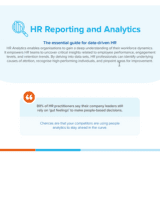
Download the infographic to discover key metrics, implementation recommendations, and practical guidance that will help your HR teams transform workforce data into strategic value.
Zalaris
Author
FAQ
Download infographic
Enter your details below to get instant access to exclusive resources.