



However, the availability of AI tools does not automatically translate into successful AI implementation. Many Australian organisations are recognising that AI adoption requires preparation across data, processes, governance, and infrastructure.
Before enabling AI-driven insights or generative AI assistants such as SAP Joule, organisations should pause and evaluate a critical question:
Is our SAP SuccessFactors environment, and our organisation, truly AI-ready?
This is where an AI readiness health check plays an important role. It helps organisations evaluate their current state, identify gaps, and plan AI initiatives that align with business objectives while reducing risk.
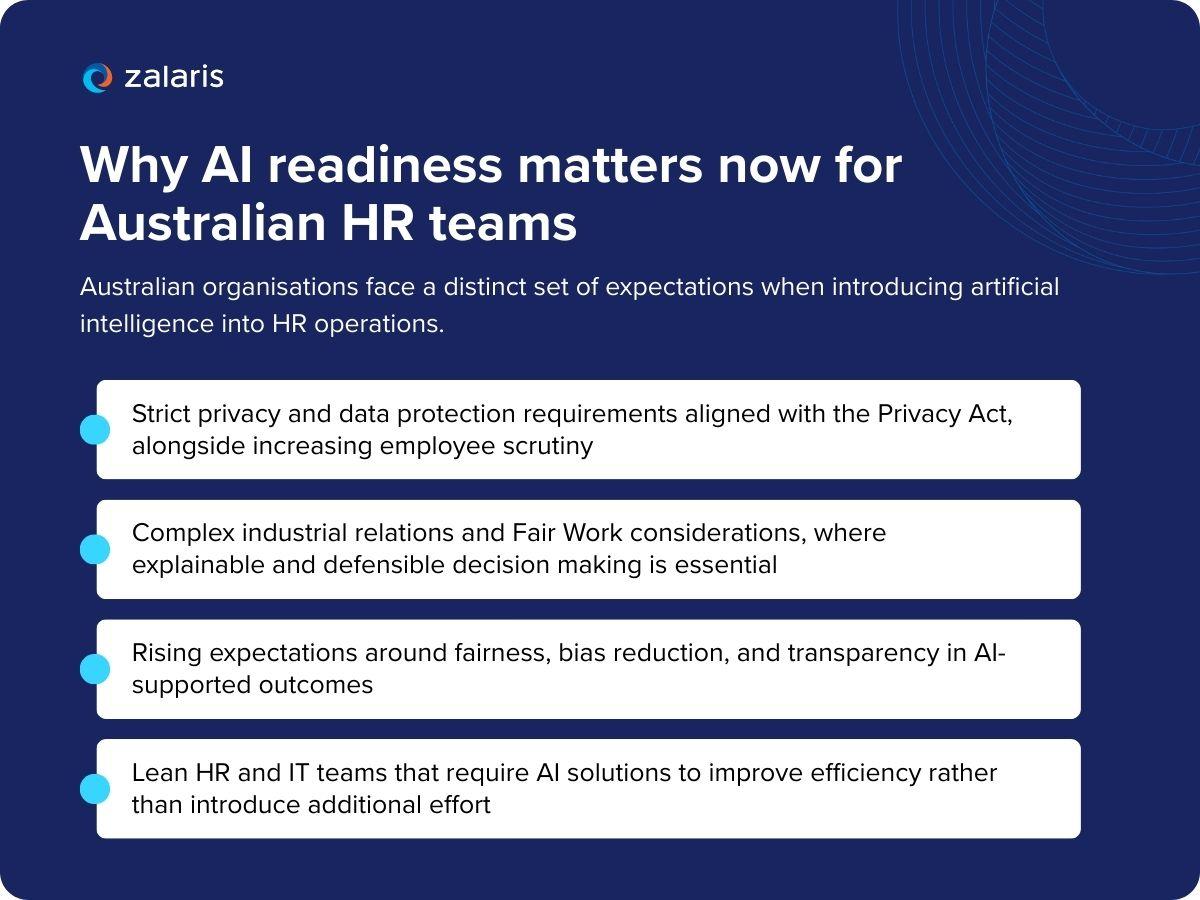
In this environment, poorly planned AI projects can undermine employee experience, create compliance exposure, and limit business value. A structured approach to AI readiness supports responsible AI adoption while positioning organisations to realise competitive advantage from their data assets.
What “AI readiness” means in SAP SuccessFactors
AI readiness is not controlled by a single setting. It reflects the strength of several foundational elements working together across systems, data sources, internal processes, and governance.
A comprehensive framework for AI readiness typically focuses on five core areas.
1. Data readiness: The foundation of trustworthy AI
AI models rely on accurate, structured data to generate reliable insights. Data quality remains one of the most common gaps organisations encounter when preparing for AI in SAP SuccessFactors.
Common challenges
- Inconsistent job titles across business units
- Outdated or incomplete Employee Central records
- Limited performance and goal history
- Skills and competencies recorded inconsistently, or not at all
Health check focus
- Accuracy and completeness of core people data
- Standardisation of job architecture and role definitions
- Confidence levels from HR leaders in existing reports
If leaders question the reliability of their data, trust in AI applications is unlikely to follow. Strong data governance enables data-driven decision making and strengthens the return on AI investments.
2. Process maturity: Don’t automate inconsistency
AI technology enhances existing processes. When processes vary across the organisation, AI systems can reinforce those inconsistencies at scale.
Before activating AI capabilities such as performance insights, talent matching, or goal recommendations, organisations should confirm how HR processes operate in practice.
Key questions
- Are performance and goal-setting processes applied consistently?
- Do managers evaluate employees using comparable criteria?
- Are recruiting stages and hiring rules clearly defined?
An AI readiness assessment often shows that process alignment is a greater barrier than technical readiness. Establishing consistency supports more effective AI adoption and improves long-term ROI.
3. Clear, business-led AI use cases
Organisations sometimes pursue AI initiatives because the technology is available rather than because it supports defined business goals. Strategic alignment is critical for successful AI adoption.
Common high-value use cases include:
- Skills gap analysis to inform workforce planning
- Learning recommendations that support capability development
- Performance insights that encourage fair and consistent evaluations
- Talent matching to strengthen internal mobility and retention
A health check helps leaders prioritise AI projects that support business needs and deliver measurable outcomes, rather than diffusing effort across too many initiatives.
4. People readiness: HR, managers, and employees
Successful AI implementation depends as much on people as it does on technology.
HR teams should feel confident explaining how AI tools generate insights and how those insights should be used. Managers need clarity that AI supports decision making, while accountability remains human. Employees expect transparency around how artificial intelligence uses organisational data.
Trust, communication, and responsible AI governance are essential. Without them, even technically sound AI solutions may struggle to gain acceptance.
5. Technical and release readiness
Organisations must also confirm that their technical environment supports evolving AI capabilities within SAP SuccessFactors.
This includes:
- Remaining current with supported releases
- Confirming AI-enabled modules are licensed and configured correctly
- Evaluating infrastructure and integration points that influence data quality
- Maintaining access to the latest AI innovations as SAP expands functionality
AI capabilities are introduced progressively. Organisations that delay upgrades may limit their ability to scale AI adoption or capture emerging business value.
How Zalaris can help
AI delivers the strongest results when built on well-governed systems, reliable data, and clearly defined objectives. Zalaris supports customers with AI readiness and SAP SuccessFactors health checks designed to evaluate preparedness and guide implementation.
Our approach helps organisations:
- Assess whether data assets, processes, and AI governance support adoption
- Identify high-impact AI use cases aligned to business objectives
- Evaluate technical and operational gaps
- Develop a practical roadmap for AI initiatives
- Plan for scalable, compliant AI systems
The focus is pragmatic and outcome-driven, helping organisations move from experimentation toward structured, successful AI.
If you are considering AI in SAP SuccessFactors, a readiness health check is a practical starting point for reducing risk, managing costs, and supporting long-term innovation.
Talk to a Zalaris expert to evaluate your AI readiness and unlock greater value from your SAP SuccessFactors investment.
FAQ