
Research from Gartner validates the scale and urgency of this transformation. Less than 25% of HR technology investments deliver maximum value, while just 35% respondents consider transformation programmes achieve intended outcomes. The gap between technology deployment and operational success has never been wider. Yet organisations that successfully navigate this transition are achieving remarkable results, with 58% of organisations citing cost savings as their primary driver for adopting managed services models. Research demonstrates that recruitment time decreases by over 15% when organisations implement integrated HR technology, while employee engagement increased by 25%.
The coming decade will separate organisations that treat HR transformation as a one-time technology implementation from those that embrace continuous operational evolution through integrated technology and managed services. This article examines five research-validated innovations reshaping enterprise HR and payroll operations and explains why they matter for organisations planning their next phase of workforce capability development, particularly in the context of an increasing global market and complex regulatory environment.
Introduction to HR Transformation
HR transformation is rapidly becoming a cornerstone of modern business strategy, enabling organisations to align their human resources functions with overarching business goals and driving sustainable growth. In today’s competitive landscape, HR professionals are no longer confined to administrative tasks; instead, they are partners who design and implement solutions that directly impact business performance, employee experience, and organisational efficiency.
At its core, HR transformation involves reimagining the way human resources operates - leveraging advanced HR technology, streamlined processes, and data-driven strategies to support both employees and the broader business. By adopting innovative HR solutions, companies can enhance productivity, reduce operational costs, and create a culture that attracts and retains top talent. This shift empowers HR teams to provide support that goes beyond compliance and administration, focusing on initiatives that foster employee engagement, learning, and development.
The expertise of HR professionals is critical throughout this journey. Their deep understanding of people management, employment law, and best practice ensures that transformation efforts are not only effective but also sustainable. By aligning HR strategy with business objectives, organisations can unlock new levels of efficiency and productivity, positioning themselves for long-term success in a rapidly evolving world of work.
Ultimately, successful HR transformation is about more than technology implementation-it’s about creating a human resources function that is agile, data-driven, and fully integrated with the company’s business strategy. This approach delivers measurable benefits for both employees and the business, setting the stage for continued growth and operational excellence.
The rise of agentic AI: From automation to autonomous operation
Artificial intelligence in HR has moved decisively beyond the pilot phase. Where early implementations focused on narrow use cases such as resume screening or chatbot responses, today’s AI agents operate with genuine autonomy across complex workflows. These systems do not simply execute predefined tasks. They make contextual decisions, learn from outcomes and orchestrate multi-step processes without human intervention.
The numbers tell a compelling story. Research from SHRM indicates that 43% of organisations now use AI-driven tools for recruitment, employee engagement and performance management. More significantly, AI can automate 40% of repetitive recruitment tasks while improving candidate identification accuracy. Early adopters report 30% reductions in time-to-hire with simultaneous widespread adoption among hiring teams.
The transformation extends well beyond talent acquisition. AI agents now handle the entire onboarding process, automating and streamlining onboarding workflows, coordinate training delivery including courses as part of comprehensive learning and development, manage benefits enquiries and track compliance requirements across multiple jurisdictions. One pharmaceutical company recently shared that their AI-driven learning operation supports six thousand scientists and manufacturing experts with a team of just ten people in learning and development, automating training delivery, compliance tracking and leadership support at scale. Generative AI is increasingly used to generate insights and personalised development opportunities for employees based on their skills and learning progress.
The distinction between traditional automation and agentic AI lies in adaptive capability. Where earlier systems followed static rules, modern AI agents interpret context, handle exceptions and improve performance through machine learning. When an employee submits a complex benefits question, AI agents can analyse policy documents, cross-reference eligibility criteria, consider regional regulations and provide personalised guidance without escalating to human support unless genuinely necessary.
For organisations evaluating their HR technology needs, the implications are profound. AI is not replacing HR professionals but fundamentally changing what strategic HR work means. Josh Bersin’s research suggests AI could handle 50% to 75% of traditional HR administrative work within the next several years. This shift frees HR leadership to focus on workforce management, organisational culture and business partnership rather than operational firefighting.
However, successful AI deployment requires more than technology acquisition. Organisations must invest in data normalisation, establish governance frameworks, and develop change management strategies that help employees trust and adopt AI-augmented workflows. The companies achieving breakthrough results treat AI implementation as an ongoing transformation journey rather than a one-time project.
Skills-first architecture: Rebuilding HR systems around capability
The traditional job-based HR model is collapsing under the weight of market velocity. According to the World Economic Forum, 39% of workers’ core skills will change within the next five years. Organisations built around static job descriptions and rigid reporting structures cannot adapt quickly enough to meet evolving business requirements or capitalise on emerging opportunities.
Skills-first architecture represents a fundamental reconception of how HR systems organise workforce data and enable talent decisions. Rather than structuring around job titles and organisational hierarchy, these systems map individual capabilities, identify skills gaps at enterprise scale and match talent to opportunities based on demonstrated competencies rather than historical roles.
The operational benefits manifest across the employee lifecycle. In recruitment, skills-based approaches expand talent pools by identifying candidates whose capabilities match requirements even when their job history appears non-traditional. During onboarding, skills assessment identifies development needs and personalises learning pathways, with a focus on building knowledge as a key outcome of skills-first approaches. For performance management, skills frameworks provide objective criteria for evaluation and create transparent advancement criteria. When pivots in business goals require workforce reallocation, skills intelligence enables rapid internal mobility without external recruitment costs.
Early evidence supports the business case for skills-first transformation. Organisations implementing skills-based hiring report 20% increases in retention as employees find roles genuinely aligned with their strengths. Internal mobility programmes powered by skills data can reduce attrition by helping employees discover growth opportunities before considering external options. Perhaps most significantly, predictive AI leveraging skills data can forecast employee turnover risk with upto 95% accuracy, enabling proactive retention interventions.
Building skills-first architecture requires significant foundational work. Organisations must develop comprehensive skills taxonomies that capture both technical competencies and human capabilities. These frameworks must integrate with core HR systems, learning platforms, and performance management tools. Employee data must be continuously updated through multiple inputs including self-assessment, manager observation, project completion and certification achievement.
The most successful implementations combine technology infrastructure with cultural change. HR people are essential stakeholders in driving skills-based transformation, ensuring that the shift is embraced across the organisation. Employees need confidence that skills transparency creates opportunity rather than surveillance. Managers require training on coaching for skill development rather than managing job completion. Leadership must model skills-based thinking by making informed decisions about capability building and workforce allocation using skills intelligence rather than intuition or organisational politics.
For enterprise HR leaders, skills-first architecture represents perhaps the single most important investment of the next decade. Organisations that successfully implement these systems gain unprecedented agility in workforce planning, dramatic improvements in talent development efficiency and the ability to redeploy internal talent at a fraction of external recruitment costs.
Unified HR and payroll service delivery: The end of fragmented vendor management
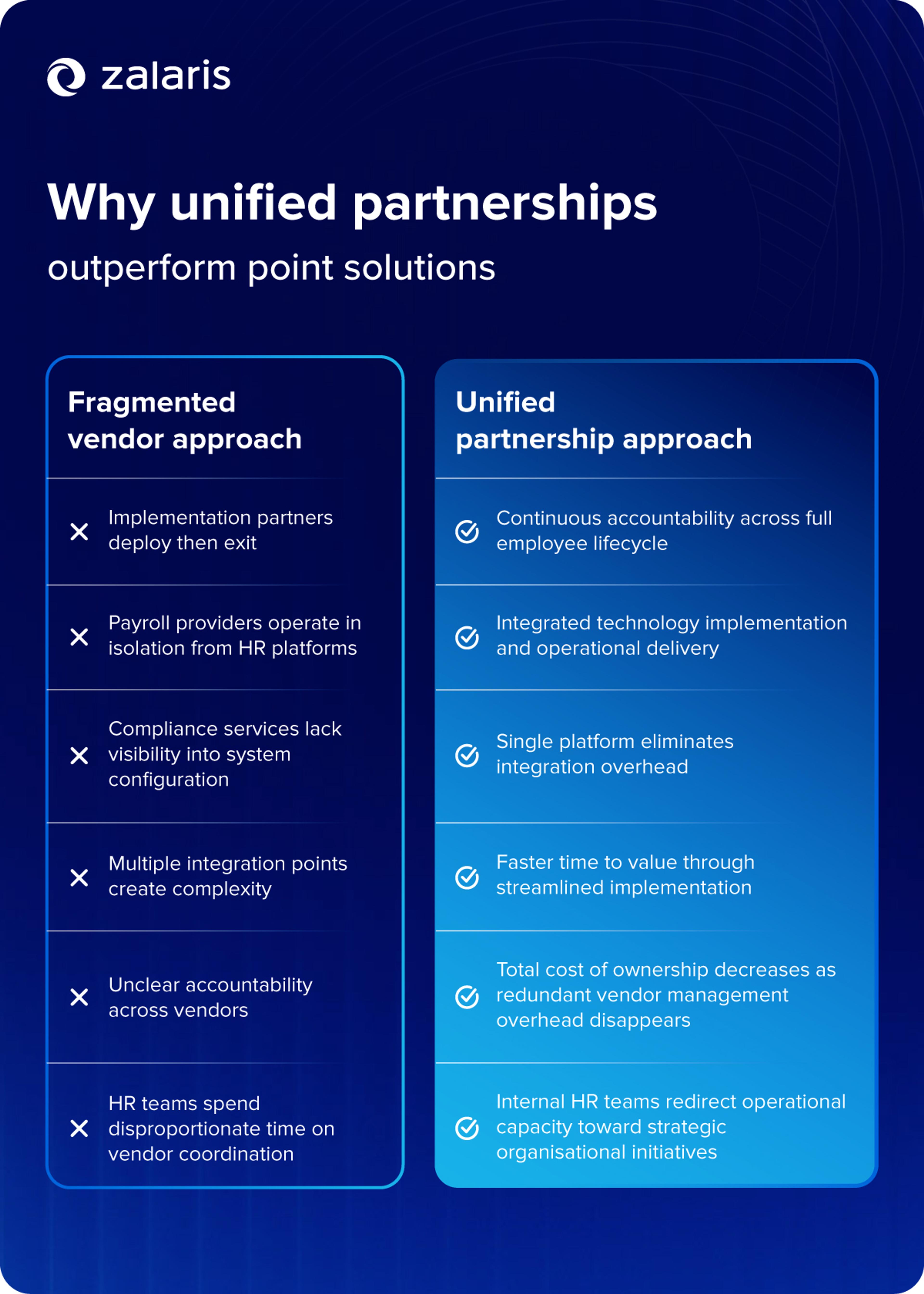
For decades, organisations have struggled with the gap between HR technology implementation and ongoing operational delivery. Implementation partners deploy systems then exit. Payroll providers operate in isolation from HR platforms. Compliance services lack visibility into system configuration. The result is fragmented accountability, integration complexity and HR teams spending disproportionate time on vendor coordination rather than workforce initiatives.
The market is responding with unified service models that integrate technology implementation, operational payroll delivery, compliance management, and continuous optimisation under single accountability frameworks. These models streamline payroll processing, improve the handling of payroll data, and provide secure access to payroll information and personal details for employees and HR teams. This represents more than vendor consolidation. It reflects a fundamental rethinking of how HR transformation should be structured and delivered. Unified services also help save time and free up valuable time for HR teams and business owners by reducing manual data entry and administrative burdens.
The payroll outsourcing market tells the story of this transformation. The global market reached nearly ten billion dollars in 2024 and is projected to reach seventeen billion by 2033, growing at a compound annual growth rate exceeding 6%. This growth is not driven by traditional outsourcing dynamics of labour arbitrage. It reflects organisations seeking comprehensive service partners who can deliver both technology capability and operational excellence through integrated models tailored for businesses of all sizes, including small businesses, to address their unique needs and challenges.
Research from multiple sources validates the operational impact of unified delivery. Organisations consolidating HR technology and managed services under single partnerships achieve faster time to value through streamlined implementation and operational transition. Total cost of ownership decreases as redundant vendor management overhead disappears, and integration complexity reduces. Perhaps most significantly, internal HR teams redirect operational capacity toward organisational initiatives as transactional work transfers to managed service partners. These unified models also ensure the protection of sensitive data and compliance with industry standards, while supporting HR people and business objectives.
The distinction between traditional outsourcing and modern unified services lies in continuous partnership rather than transactional service delivery. Where legacy outsourcing focused on cost per transaction, unified models measure success through business outcomes: improved compliance rates, faster scaling into new markets, enhanced employee experience, and increased HR capability. Service providers maintain accountability across the full HR lifecycle rather than narrow operational windows. Achieving buy-in from employees and leadership is essential for successful change management and adoption of new systems.
Cloud-based platforms enable this integration by providing common data architectures that eliminate the integration challenges that historically plagued multi-vendor environments. When implementation teams, payroll processors and compliance specialists all operate within unified platforms, data flows seamlessly, governance simplifies and accountability clarifies. These platforms also offer interoperability with other software, allowing seamless data sharing with payroll, ERP, ATS, and accounting systems. The cloud payroll solutions market alone is projected to grow from $11.7 billion in 2023 to $23.3 biliion by 2031, with a compound annual growth rate of nearly 11%.
For organisations evaluating HR transformation partnerships, the question has shifted from “Should we outsource?” to “How do we structure partnerships that deliver both transformation and operational excellence?” The answer increasingly involves selecting service partners capable of implementing technology, operating processes, and continuously optimising performance through integrated accountability models. HR consultants play a crucial role by providing advice, HR support, and addressing HR issues and HR processes, ensuring businesses receive expert guidance and solutions tailored to their needs.
Predictive workforce intelligence: From reporting to foresight
HR analytics has evolved from backward-looking reporting to forward-looking workforce intelligence. Modern systems leverage AI and machine learning to predict turnover risk, identify skills gaps before they impact operations, forecast hiring needs based on business pipeline, and recommend targeted interventions that improve workforce outcomes.
The operational applications span the entire employee lifecycle. Predictive analytics identify flight risk among high-potential employees, enabling proactive retention conversations before resignation notices arrive. Skills gap analysis forecasts capability deficits eighteen to twenty-four months in advance, providing sufficient runway for development programmes or strategic hiring. Engagement analytics detect team-level dissatisfaction faster than traditional surveys, allowing immediate managerial intervention.
The business impact extends beyond HR efficiency. It is now widely known that leveraging data-driven workforce decisions results in productivity improvements. When workforce planning connects directly to business goals through predictive intelligence, organisations can scale operations faster, enter new markets with confidence and adapt to disruption more effectively than competitors relying on intuition and lagging indicators.
Successful predictive intelligence requires more than analytical tools. Data quality determines model accuracy. Organisations must invest in data governance, standardise taxonomies across systems, and ensure continuous data hygiene. Integration matters profoundly. Predictive models require inputs from HRIS systems, performance platforms, learning management systems, compensation tools, and even external labour market data. Siloed systems cannot deliver comprehensive insights that drive strategic advantage.
Perhaps most critically, predictive intelligence demands cultural readiness. Many organisations struggle to act on predictions even when data clearly indicates necessary interventions. HR leaders must develop influence with business leadership to translate workforce intelligence into actionable insights. Managers need training in interpreting analytics and confidence to make data-informed people decisions rather than relying solely on subjective judgment.
The next frontier involves integrating predictive workforce intelligence with business performance data to demonstrate causal relationships between HR interventions and financial outcomes. When organisations can definitively show how targeted development programmes improve innovation metrics, or how retention strategies impact customer satisfaction scores, the importance of HR transforms fundamentally.
Multi-country payroll complexity: The compliance imperative driving consolidation
Global workforce expansion creates extraordinary operational complexity in payroll management. Each country has unique tax regulations, statutory reporting requirements, currency considerations, and employment law frameworks. Managing this complexity through multiple regional vendors creates integration nightmares, governance challenges and substantial compliance risk.
The trend toward consolidated multi-country payroll solutions reflects both technological capability and a key necessity. Cloud platforms can now handle currency conversion, tax calculation and statutory reporting across dozens of jurisdictions from unified architectures. More importantly, organisations recognise that payroll compliance failures carry severe consequences ranging from financial penalties to reputational damage and criminal liability for executives.
Australia's wage theft legislation, effective January 2025, exemplifies the regulatory environment driving this consolidation. The law imposes fines reaching eight million dollars and potential imprisonment for intentional underpayment of employees. Similar regulatory tightening is occurring across European jurisdictions as governments crack down on employment violations. Organisations cannot afford the compliance gaps that emerge from fragmented payroll vendor management.
Research indicates that fifteen percent of companies with fewer than twenty-five hundred employees outsource payroll operations, compared with just eight percent of those exceeding ten thousand employees. This seemingly counterintuitive statistic reflects the disproportionate compliance burden smaller organisations face when expanding internationally. Without internal expertise spanning multiple jurisdictions, these companies face extraordinary risk managing payroll through distributed vendors or in-house teams.
The operational benefits of consolidated multi-country payroll extend beyond compliance. Unified platforms provide real-time visibility into global payroll costs, enable standardised reporting across geographies and simplify audit processes. When acquisitions bring new countries into the portfolio, consolidated platforms can onboard new jurisdictions without the complexity of evaluating and integrating new vendor relationships.
However, consolidation raises important questions about balancing standardisation with local requirements. Effective multi-country platforms must accommodate genuine regional differences in employment practices, cultural norms and regulatory frameworks while maintaining global governance and data standards. The ideal providers combine centralised technology platforms with local expertise that understands regional nuances and can navigate relationships with local tax authorities and labour regulators.

For organisations planning international expansion, payroll strategy deserves executive attention alongside market entry and operational scaling plans. The decision to consolidate multi-country payroll delivery under unified service partners versus managing regional vendors independently has profound implications for compliance risk, operational efficiency, and organisational agility. As regulatory environments tighten globally and workforce models diversify, this decision only increases in importance.
The integration imperative: Why unified partnerships outperform point solutions
A pattern emerges across these five innovations. Organisations achieving breakthrough results do not implement technologies and services in isolation. They structure integrated partnerships that deliver technology deployment, operational management and continuous optimisation through unified accountability.
HR technology investments fail to deliver maximum value when organisations treat implementation as a one-time project and operations as a separate concern. The execution gap between system deployment and operational excellence explains why HR transformation programmes fail to achieve intended outcomes despite selecting appropriate technology.
Conversely, organisations that consolidate technology implementation and managed services succeed from eliminating the handover complexity, integration overhead, and unclear accountability that plague fragmented vendor models.
The next decade will see continued convergence between HR technology platforms, application management services, payroll operations, and compliance delivery. Organisations structuring partnerships around this convergence will gain decisive advantages in workforce agility, operational efficiency and capability. Those continuing with fragmented point solutions will face escalating complexity as workforce models diversify; regulatory requirements intensify, and business velocity accelerates.
Looking forward: What this means for enterprise HR strategy
The five innovations examined in this article share common threads. Each requires substantial foundational work in data architecture, integration capability, and change management. Each delivers compounding value over time rather than immediate return. Each demands partnerships with service providers who can maintain commitment across transformation journeys measured in years rather than months.
For CHROs and senior HR leaders planning the next phase of workforce capability development, several key principles emerge. Technology selection matters less than partnership structure. The question is not which HR platform to implement but rather which service partner can deliver both technological capability and operational excellence through integrated accountability models.
Investment should flow toward foundational capabilities that enable multiple innovations rather than point solutions addressing isolated problems. Data governance, skills taxonomies, predictive analytics infrastructure and integration platforms create the architecture on which AI agents, skills-first systems and workforce intelligence operate. These foundations deliver value across the entire HR technology ecosystem rather than within narrow applications.
Change management deserves equal investment to technology deployment. The organisations achieving breakthrough results treat transformation as continuous organisational capability building rather than one-time system implementation. They invest in helping employees adopt new workflows, develop managers as coaches rather than administrators, and build executive confidence in data-driven workforce decisions.
Finally, success requires an honest assessment of internal capability. Many organisations lack the expertise to implement advanced HR technologies, operate complex payroll processes across multiple jurisdictions, and continuously optimise performance while maintaining full-time focus on workforce initiatives. Acknowledging this reality and structuring partnerships with service providers who can deliver both transformation and ongoing operational excellence represents strategic wisdom rather than admission of weakness.
The operational revolution in HR and payroll is not coming. It is here. The question facing enterprise leaders is not whether to transform but rather how to structure partnerships and investments that deliver sustained competitive advantage through superior workforce capability. The next decade belongs to organisations that embrace continuous transformation through integrated technology and managed services rather than those treating HR systems as one-time implementations requiring only occasional upgrades.
About Zalaris
Zalaris delivers complete lifecycle accountability through our One Partner model, from implementation through ongoing operations. Explore how unified partnership eliminates fragmentation, accelerates deployment and delivers measurable outcomes across your entire HR infrastructure.