
This guide provides that clarity. It maps the real use cases delivering measurable value today, separates genuine machine learning from rules-based logic wearing an AI badge, and gives you a phased roadmap grounded in deployment reality rather than vendor promises.
The promise vs. the reality of AI in payroll
The phrase AI-powered payroll is doing a lot of heavy lifting right now. Vendor presentations deck it out in neon lights. Conference agendas dedicate entire tracks to it. And somewhere between the keynote and the cocktail hour, even the most level-headed HR director finds themselves wondering whether their payroll team is about to be replaced by a large language model.
They won't be. But that doesn't mean nothing is changing.
SAP released more than 250 new features in the first half of 2025, a significant proportion of them AI-powered, with further releases into 2026. Other HR technology vendors have been equally prolific. The market is genuinely innovating, especially in areas such as global payroll, employee experience, and workforce planning. It is also generating noise. For every capability that delivers measurable value, there are three that sound compelling in a demo and sit dormant in production.
This guide is for organisations that want to move beyond the hype. It covers what AI and predictive analytics in payroll looks like today, which use cases are delivering value, what the prerequisites are before you invest, and how to build a phased roadmap proportionate to your organisation's readiness. It is grounded in real-world deployment experience, not vendor slide decks.

Real AI capabilities in modern payroll systems
Before examining specific use cases, it is worth calibrating what 'AI' actually means in the context of payroll. The term covers a spectrum of technologies, and not all of them are equal in maturity or applicability.
| Technology | What it does | Maturity in payroll today |
|---|---|---|
| Rules-based automation | Executes predefined logic; no learning involved | Mature. Most payroll platforms already rely on this |
| Machine learning (ML) | Identifies patterns in historical data to make predictions | Emerging. Solid use cases in anomaly detection and forecasting |
| Natural language processing (NLP) | Understands and generates human language | Understands and generates human language |
| Generative AI (GenAI) | Produces new content, explanations or code from prompts | Very early. Mostly co-pilot features; high risk if unmonitored |
| Predictive analytics | Uses statistical models to forecast future outcomes | Proven ROI. Spend forecasting, headcount modelling, attrition signals |
The important implication of this spectrum: rules-based automation is not AI, even when vendors label it as such. When a payroll system automatically applies a tax rate update or flags a missing cost centre, that is logic, not learning. Genuine machine learning requires sufficient historical data, model training and ongoing governance. That is a meaningful bar that many organisations have not yet cleared.
The honest test: does the system learn from new data, or does it follow a flowchart? If it's the latter, call it automation. It's valuable -- but it isn't AI.
Practical use cases that are delivering value
Three use cases have moved beyond proof-of-concept and are producing measurable results in production environments today.
1. Anomaly detection and error prevention
This is the most immediately valuable application of ML in payroll, and arguably the most underappreciated. Traditional payroll auditing relies on deterministic checks: if a value falls outside a predefined range, flag it. ML-based anomaly detection is different. It builds a statistical model of what a normal payroll run looks like for a given employee cohort, and surfaces deviations that rule-based logic would miss.
What anomaly detection catches that rules-based systems miss
A benefits deduction that is individually correct but anomalous relative to an employee's historical pattern Gradual salary drift across a team that no single pay period triggers, but a trend model identifies over six months Duplicate payments masked by legitimate variation in hours or allowances Pension contribution inconsistencies caused by integration lag between HR and payroll systems Ghost employee patterns: subtle signatures in new starter records that mirror reinstated-after-termination fraud
2. Payroll spend forecasting
Finance and HR leaders have always needed to answer the same question: what will our people costs be next quarter? Historically, the answer arrives via a combination of static headcount plans and manually maintained spreadsheets -- a process that is both slow and fragile.
Predictive spend forecasting uses ML models trained on payroll history, HR master data and business planning inputs to produce rolling forecasts with quantified confidence intervals. The practical benefits are significant. AI uses historical payroll data to provide predictive insights for strategic decision-making, transforming payroll processes from reactive to proactive and strategic functions. Predictive analytics help manage payroll costs and workforce planning by forecasting labor costs, identifying trends, and supporting strategic priorities:
- Scenario planning becomes genuinely dynamic. Model the payroll cost impact of a new hire ramp, a restructuring or a shift premium change in minutes rather than days.
- Finance and HR operate from a shared data model, reducing the friction that accompanies most budgeting cycles.
- Variance explanations are generated automatically, reducing the manual analytical burden on payroll teams.
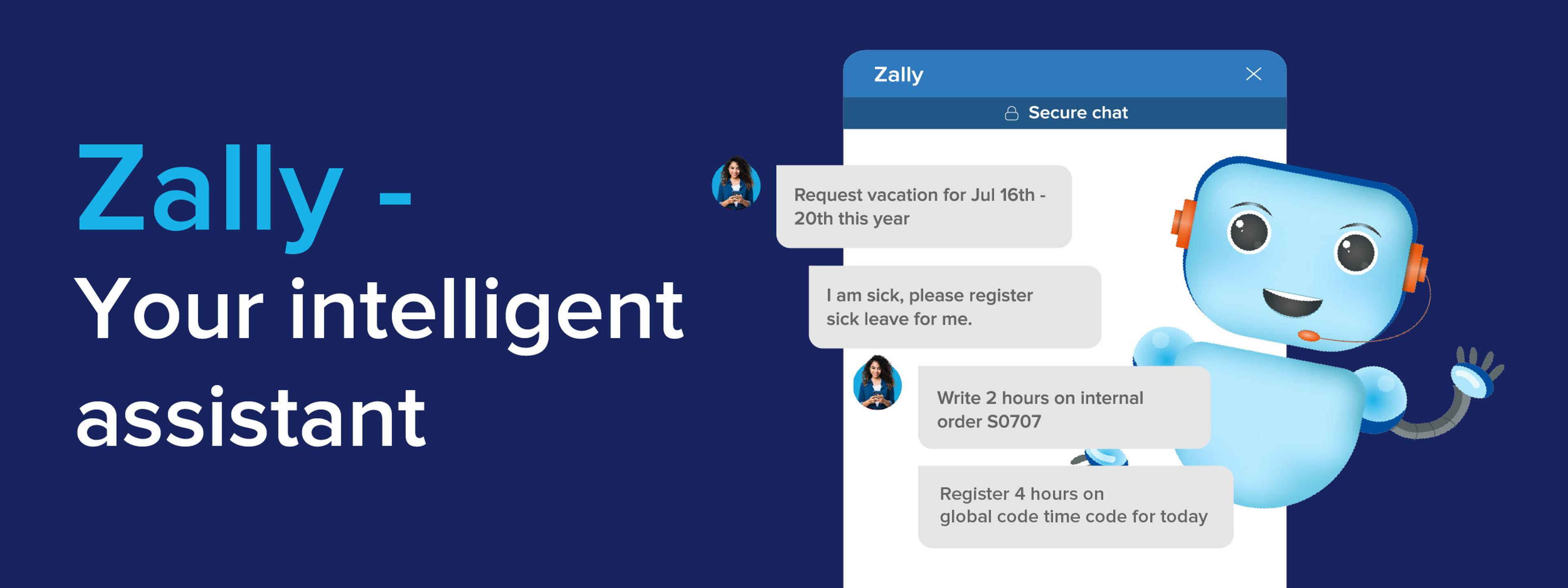
3. Conversational interfaces and chatbot support
NLP-powered AI chatbots for HR and payroll queries have had a chequered history. Early deployments were rigid, brittle, and often more frustrating than a well-organised FAQ page. The picture has changed materially with large language models powering the inference layer.
The current generation of ai chatbots in payroll -- when properly scoped and governed -- can handle routine queries effectively: payslip explanations, leave balance checks, benefit entitlement questions and process guidance. These ai chatbots provide 24/7 support, automate data collection, and analyse data from interactions to improve responses and gain insights into employee needs and preferences. This not only reduces the administrative burden on HR teams but also enhances employee experience and employee satisfaction by providing instant access to payroll information and self-service options.
The key caveats are scoping (do not let a chatbot handle complex compliance queries without escalation logic) and transparency (employees should always know when they are talking to a system, not a person).
Common misconceptions and the hype worth ignoring
For every real capability described above, there is a corresponding piece of vendor marketing that overstates what AI can do in payroll today. These are the most common misconceptions worth stress-testing when you evaluate platforms.
Readiness assessment: are you actually ready?
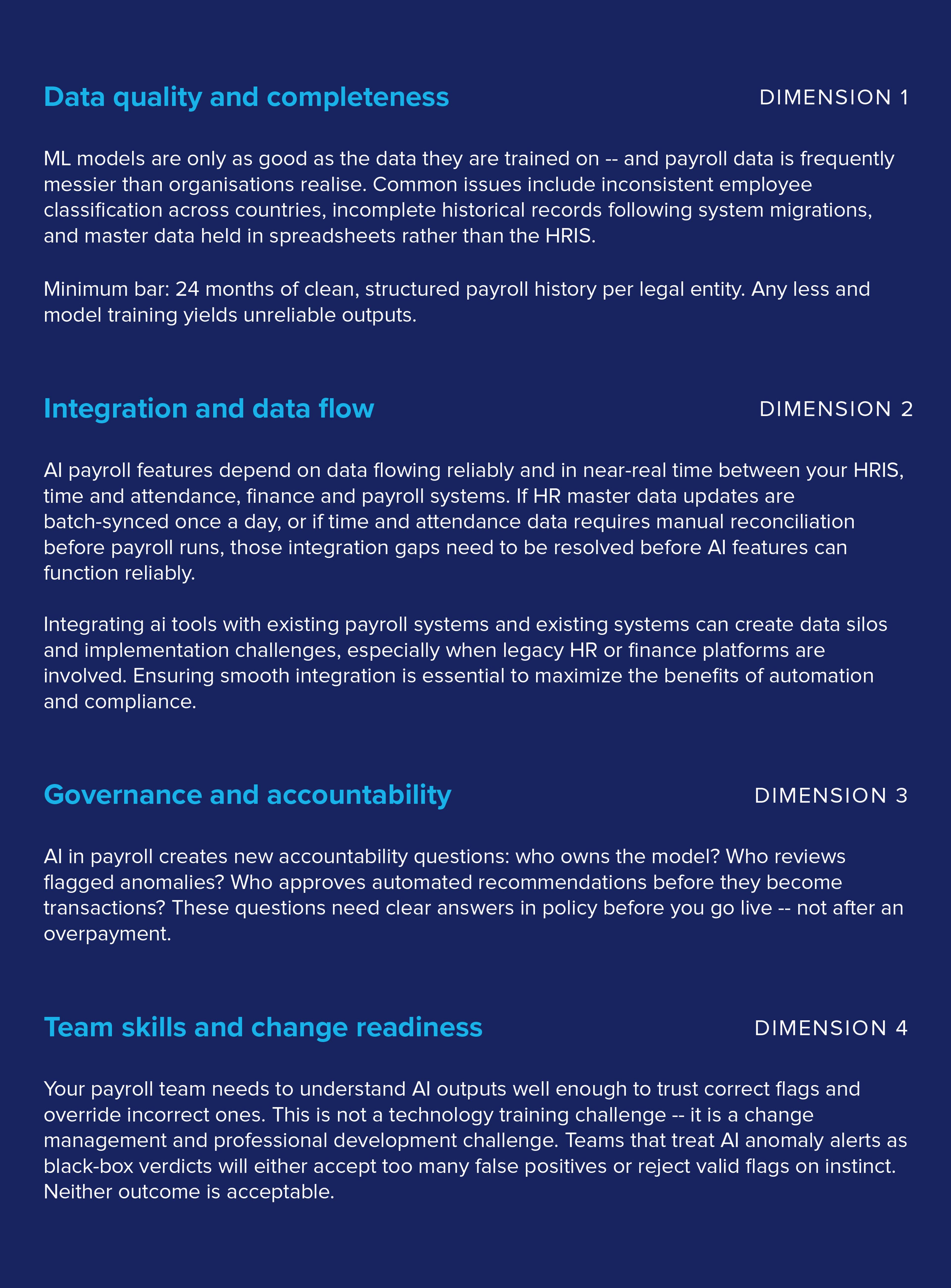
The single biggest predictor of AI payroll programme success is not the technology chosen. It is the organisation's data and process maturity going in. There are four dimensions to assess honestly before committing to an AI-powered payroll roadmap.
Phased implementation roadmap
A realistic AI payroll roadmap has three phases, each building the foundations for the next. The timelines below are indicative; actual durations will vary based on starting complexity and internal capacity.
| Phase | Focus | Key activities | Typical duration |
|---|---|---|---|
| Phase 1: Foundation | Data and integration hygiene | Audit payroll master data quality; resolve HRIS-to-payroll integration gaps; document exception handling processes; establish data governance framework; baseline current error rates and processing time | 3-6 months |
| Phase 2: Pilot | Targeted AI deployment in controlled scope | Deploy anomaly detection on highest-volume payroll entities; train model on 24+ months of clean data; run shadow mode (AI flags, humans decide) before any automation; establish review and override protocols | 4-8 months |
| Phase 3: Scale and optimise | Expand, automate selectively, govern continuously | Extend anomaly detection across remaining entities; introduce conversational interfaces for tier-1 employee queries; automate lowest-risk exception resolutions; establish model performance monitoring; conduct quarterly bias and accuracy audits | 6-12 months+ |
Move slowly in Phase 1 so you can move confidently in Phase 3. Organisations that rush to deploy AI before cleaning their data almost always end up in remediation by Phase 2.
Governance, oversight and explainability
AI governance in payroll is not a compliance exercise. It is a trust exercise. Your employees receive their income through your payroll system. If AI-influenced decisions create errors, the human consequence is immediate and tangible. Governance frameworks need to reflect that responsibility.
Human expertise and professional oversight are essential for handling exceptions, ensuring ethical standards, and interpreting complex regulations. While AI systems can automate and enhance many payroll processes, their decision-making can be opaque, complicating payroll auditing and requiring experienced payroll professionals to provide judgment and oversight. A human-in-the-loop approach ensures that AI-powered payroll systems remain transparent, fair, and compliant.
Bias detection
Payroll ML models trained on historical data can encode historical inequities. A model trained to flag anomalous salaries may reflect and perpetuate pay gaps if the training data contains them. Bias audits -- examining model outputs disaggregated by gender, age, ethnicity and other protected characteristics -- should be a mandatory quarterly activity, not an optional one.
Audit trails
Every AI-influenced payroll decision -- a flagged anomaly, a recommended correction, an automated approval -- should be logged with a timestamped record of the model output, the human review decision and the final outcome. This is not bureaucracy; it is the minimum required for meaningful audit and regulatory inquiry response.
Explainability
When an anomaly detection model flags an employee's deduction as unusual, the payroll professional reviewing that flag needs to understand why. Systems that produce opaque verdicts -- 'anomalous: confidence 87%' -- without supporting evidence undermine operator trust and increase the likelihood of both false positive acceptance and false negative dismissal. Require human-readable explanations as a procurement criterion.
Skills and training: building the human side
AI payroll does not eliminate the need for payroll expertise. It changes what that expertise needs to include. The organisations that get the most from these tools are those that invest in upskilling their payroll and HR teams to work alongside AI, not around it. Continuous upskilling in data literacy and AI management is essential for payroll teams to effectively work alongside AI systems and maximise the value of these technologies.
| Role | New skills required |
|---|---|
| Payroll manager | Understanding of ML model principles; statistical literacy; ability to interpret confidence scores and error distributions; governance accountability |
| Payroll analyst | Structured exception review methodology; distinguishing AI-generated alerts from manual flags; feedback loop participation (marking false positives) |
| HR business partner | Data literacy; understanding what predictive models can and cannot tell you about workforce trends; responsible AI principles |
| HR IT / payroll technology lead | Model monitoring; integration health management; vendor AI feature roadmap evaluation; data quality ownership |
| Finance / FP&A | Interpreting AI-generated spend forecasts; understanding confidence intervals and scenario assumptions; HRIS/payroll data governance |
Platform architecture: why the foundation matters
The capabilities described throughout this guide are not features that exist independently of platform architecture. Anomaly detection needs clean, structured data flowing reliably between systems. Spend forecasting needs a real-time HR data layer. Conversational AI needs an integrated knowledge base and a governed escalation path.
Deeper integration between payroll, HR, and finance systems is critical. AI solutions can provide a competitive edge by enabling unified workflows, seamless access to labor costs, time tracking, and compliance information, and supporting strategic priorities across global payroll operations.
This is why the conversation about AI in payroll is, at its foundation, a conversation about HR and payroll system architecture. Organisations running disconnected point solutions -- separate HRIS, payroll and time systems with batch integration -- face a meaningful structural constraint on what AI capabilities they can deploy, regardless of which specific features their payroll vendor releases.
AI features do not compensate for fragmented architecture. Before you evaluate AI capabilities, evaluate whether your platform can actually support them.
Purpose-built platforms that deliver HR and payroll within a unified, cloud-native architecture - such as Zalaris PeopleHub, which combines SAP SuccessFactors with pre-configured, best-practice payroll processes in a managed service model -- provide the structural conditions that AI capabilities require to function reliably. The value is not in the AI features themselves; it is in the clean data, real-time integrations and governance framework that a well-designed platform makes available from day one.
Organisations evaluating AI-powered payroll features should treat architectural fitness as a prerequisite question, not an afterthought.

Data security and compliance: Safeguarding payroll in the age of AI
As artificial intelligence becomes increasingly embedded in payroll management across organisations, the stakes for data security and compliance have reached unprecedented heights. Payroll data stands as among the most sensitive information any organisation holds, encompassing not merely salary figures, but also personal identifiers, banking details, tax information, and comprehensive employment histories. For payroll teams and payroll professionals navigating this landscape, protecting such data represents both a fundamental legal obligation and a cornerstone of organisational trust.
AI integration within payroll operations brings considerable advantages, from automating repetitive administrative tasks to dramatically reducing human error and streamlining complex payroll processes. However, the adoption of AI-powered tools into existing payroll systems simultaneously introduces new categories of risk that demand careful consideration. These automated systems process vast quantities of employee data at unprecedented speed and scale, making them increasingly attractive targets for sophisticated cyber threats while amplifying the potential impact of any security breach or costly operational error.
To safeguard payroll data effectively, organisations must ensure their payroll systems incorporate robust data security measures at every operational layer. This encompasses end-to-end encryption protocols, stringent access control mechanisms, and continuous monitoring capabilities for suspicious activity patterns. AI-powered anomaly detection emerges as a crucial component here, serving not merely to identify payroll processing errors, but also to flag unusual access patterns or potential fraud attempts in real time, creating a comprehensive security ecosystem.
Compliance requirements prove equally critical in this evolving landscape. Payroll professionals must navigate an increasingly complex web of local and international regulations governing data privacy frameworks, tax legislation, and employee rights protections. AI-powered payroll management tools can provide substantial support by automatically tracking regulatory changes as they emerge, validating data against current compliance requirements, and generating audit-ready reports that meet evolving standards. This approach significantly reduces the risk of non-compliance incidents and the costly penalties that invariably result from regulatory violations.
Ultimately, the strategic adoption of AI within payroll operations must be accompanied by a renewed and intensified focus on comprehensive data governance practices. Payroll teams should regularly audit who maintains access to payroll data, ensure that AI systems demonstrate transparency in their decision-making processes, and maintain clear, comprehensive audit trails for every automated action performed. By combining advanced AI-powered tools with rigorous data security protocols and proactive compliance practices, organisations can future-proof their payroll operations, protecting both their employees' sensitive information and their organisational reputation in an increasingly digitalised HR and Payroll environment.
The honest bottom line
AI and predictive analytics in payroll are real, they are maturing, and organisations that invest thoughtfully in the foundations today will have a meaningful operational advantage in three to five years. But the technology is not magic, and vendors are not always candid about what it requires.
AI-powered payroll software delivers cost reduction by decreasing payroll costs, minimizing errors, and streamlining compliance with complex regulations. Automation reduces manual work and routine tasks, freeing HR teams to focus on higher-value activities and improving overall employee satisfaction.
The organisations that succeed with AI in payroll are not necessarily those with the largest technology budgets or the most ambitious roadmaps. They are the ones that invested seriously in data quality before anything else, built governance frameworks that matched the accountability stakes involved in paying people, and approached AI as a tool that makes skilled payroll professionals more effective, not a substitute for them.
That is a less exciting story than any keynote promises. But it is the one that ends with a working system, a satisfied team, and a payroll that runs accurately, which is, ultimately, the only outcome that matters.
Are you ready to find out what AI enhancements can do for your payroll operations? Get in touch with our team and we will be happy to help!
FAQ

Elliot Raba
Enterprise Sales Executive
Elliot is a dynamic and results-driven Enterprise Sales Executive at Zalaris UK&I, where he excels in crafting innovative solutions that address the unique needs of his clients. With a keen understanding of the intricacies of enterprise level operations, Elliot leverages his extensive industry knowledge to drive business growth and foster lasting partnerships.