
 Back to Blogs
HR Business Partner (HRBP): A strategic role in modern organisations
Outdated perceptions of HR are holding organisations back. When treated as purely administrative, HR risks being isolated from strategic decision-making. This article shows how the Human Resources Business Partner (HRBP) model elevates HR from a support role to a strategic driver of business success, and the tools to make that shift possible.
Elliot Raba
17.12.2025 · 7 min read



Complex workforce demands require more from HR. Part-time employees, remote and contracted workers create unique challenges. Meanwhile, businesses face increasingly tough economic conditions, a more competitive market, and the rise of AI. HRBPs provide the solution by aligning HR practices with business needs.
What is an HR Business Partner?
An HR Business Partner (HRBP) is a senior HR professional who works closely with business leaders to align human resources practices with strategic objectives. Rather than focusing solely on administrative tasks, the HRBP role is grounded in proactive business involvement, contributing to decisions that shape the company's direction.
The origins of the HRBP role
The concept gained prominence through Dave Ulrich’s HR Business Partner model, introduced in his 1997 book Human Resource Champions. At the time, traditional HR practices weren’t adequately addressing complex business needs and HR tasks were often considered an administrative overhead rather than a strategic contributor.
Ulrich’s model turned HR professionals into a bridge between people and the rest of the business. They would understand the business challenges and leverage their HR expertise to develop solutions, unleashing the modern HR transformation.
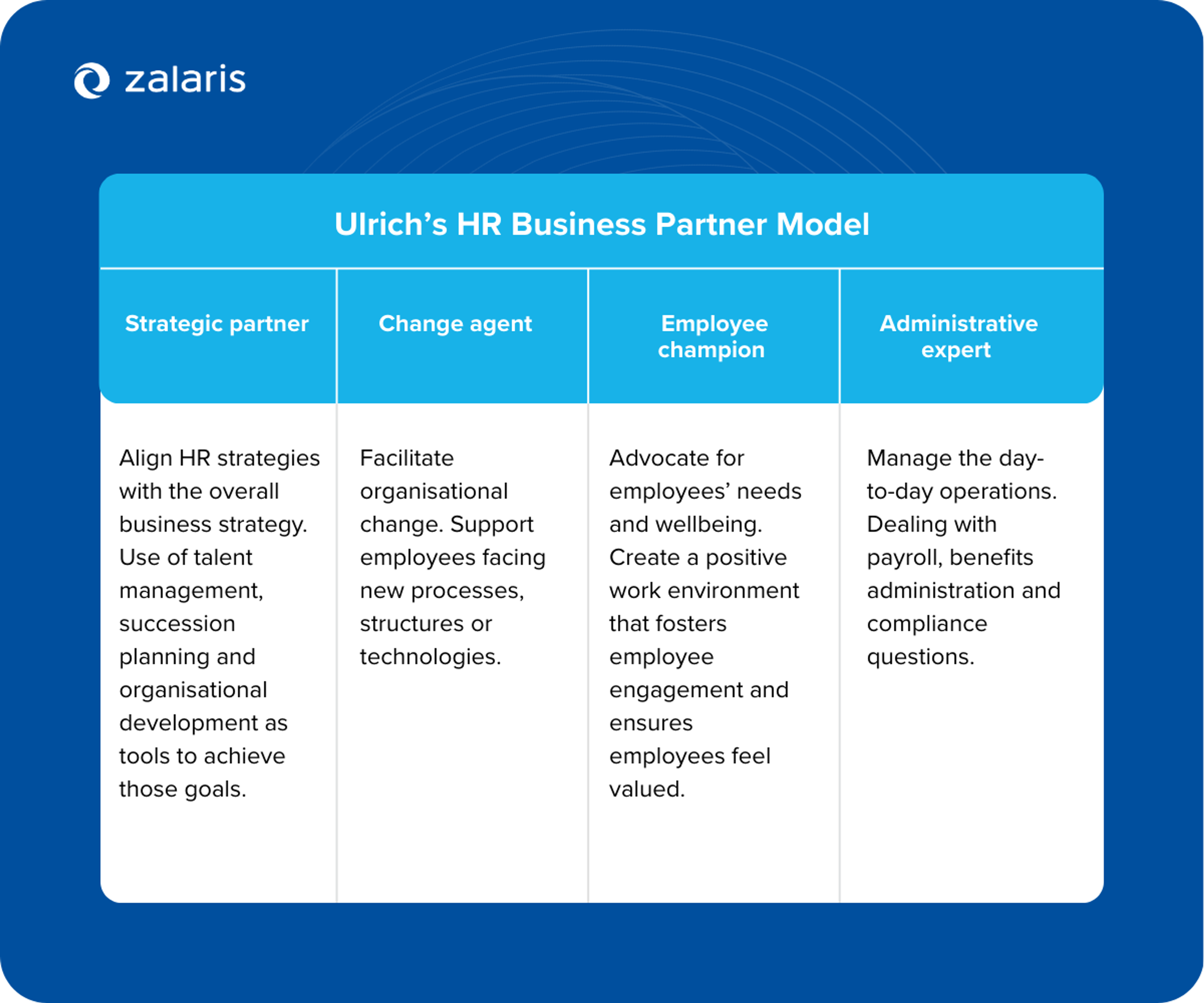
HRBPs - A strategic link between HR and business
Working with teams, managers and key stakeholders requires a strong understanding of the organisation, its strategy, customers and employees.
Andrew White, chair of the executive leadership program me at Australian business school Griffith University, told People Management “In a world preoccupied with artificial intelligence and machine learning, our studies show that human behavior is the most prescient influence in driving transformation.”
This focus on human behaviour is exactly where HRBPs bring value: understanding and influencing people to achieve business goals.
Core responsibilities of HR Business Partners
While typically assigned to a particular area of business, the scope of their role varies depending on the organisation's size and structure. HRBPs tailor HR strategy to operational goals and help leaders drive performance while enhancing the employee experience.
These are the key responsibilities that define an HRBP’s role at a glance:
- Acting as a trusted advisor to business leaders
- Aligning workforce planning with business objectives
- Advising leadership on people-related strategy
- Identifying and addressing capability gaps
- Supporting change management initiatives
- Analysing HR data to influence decisions
- Driving diversity, equity, and inclusion initiatives
- Enabling talent development and succession planning
How dedicated HRBPs strengthen organisational performance
Having a dedicated HRBP allows HR to contribute meaningfully to business outcomes. According to a Gartner report, organisations with a strategic HR function are 1.4 times more likely to report effective leadership and 1.3 times more likely to outperform their peers on financial targets.
In practice, effective HRBPs help organisations to:
- Enhance the strategic alignment: Traditional HR often operates in silos. HRBPs bridge this gap and create actionable strategies.
- Improve talent acquisition and retention: A positive employer brand is vital, and comprehensive onboarding and retention programmes help nurture this image.
- Boost employee engagement and productivity: The positive work environment, supported through effective communication and recognition programmes, enhances overall employee wellbeing and productivity.
- Mitigate level and compliance risks: Non-compliance with labour laws costs both real money and reputation, and HRBPs help minimise these risks.
- Optimise cost management: Inefficiencies are among the biggest cost elements in organisations. HRBPs' use HR data toidentify cost-saving opportunities and solutions.
By working closely with department heads, HRBPs create more resilient and adaptable workforces that can respond to shifting market or operational demands.
Differences between HR Business Partners and other HR roles
As an organisation, finding the right people for the right roles is a key challenge. An important part of this process is understanding the distinct responsibilities of each role. For HR Business Partners, their core tasks and required skills differ from those of traditional HR roles.
| Role | HR generalist | HR manager | HRBP |
|---|---|---|---|
| Focus | Broad HR support across functions | Operational HR, compliance, process delivery | Strategic alignment, business advisory, people strategy |
| Positioning | Execution across operational and administrative areas | Centralised HR function | Embedded in business units |
While HR Managers often focus on policy implementation, compliance, and day-to-day operations, HRBPs take a strategic, forward-looking approach. Their work is consultative and collaborative, not purely operational.

The collaborative role of HRBPs within HR teams
Even when assigned to a specific department, HRBPs should not operate in isolation. They need visibility and access across HR functions as well as the wider business. To be effective, they collaborate closely with:
- HR centres of excellence for expertise in learning, compensation and other specialist areas
- HR operations for service delivery and data
- Business leaders to influence and support people strategy
- Finance to support workforce planning, headcount forecasting, and budgeting
- IT teams to enable system integration, data flows, and digital transformation initiatives
- Legal and compliance departmentsthat manage regulatory requirements and mitigate risk
- Internal communications to align messaging around key people initiatives and organisational change
This collaboration ensures HRBPs have the data, insights, and infrastructure to contribute at a strategic level.
Empowering the HRBP role withtechnology and external support
For HR business partners to operate effectively, access to centralised data, automation, and real-time insight is essential. Scattered systems and inconsistent data hinder their ability to contribute strategically. Leveraging modern HR technology and external expertise can elevate the HRBP role, providing the tools needed for greater visibility, improved efficiency, and informed, proactive decision-making.
Practical technology use cases for HRBPs
For HR business partners to operate effectively, access to centralised data, automation and real-time insight is essential. Scattered systems and inconsistent information make it difficult for them to contribute strategically. Modern HR technologies provide the visibility and efficiency HRBPs need to move beyond operational work and take a more proactive role in shaping business outcomes.
Practical use cases include:
Workforce insight and reporting: HRBPs can monitor trends through dashboards, predictive analytics and KPIs to identify skills gaps, assess turnover risks and model future scenarios.
Performance and talent development: Integrated tools for goals, learning and succession planning help HRBPs align employee development with organisational needs.
Change management and transformation: Digital platforms support communication, engagement tracking and analytics during restructures, mergers or HR digitalisation.
Compliance alignment: Automated workflows and region-specific configurations help HRBPs manage GDPR and local labour law requirements.
Time, attendance and compensation planning: Integrated solutions make it easier for HRBPs to contribute to everyday workforce decisions.
With solutions such as SAP SuccessFactors, administered byZalaris, organisations gain a single, reliable platform that brings these capabilities together. Combined with external expertise like Zalaris’ HR Partner Plus service, HRBPs are empowered not only with data and automation but also with the strategic support needed to drive transformation.
Get on-demand HRBPs: HR Partner Plus by Zalaris
HR business partners are critical to bridging people strategy and business performance. With the right tools and support, they can move beyond operational tasks and become trusted advisers to leadership.
Organisations looking to leverage external support and expertise can also benefit from Zalaris’ HR Partner Plus programme: a flexible, on-demand service that provides direct access to experienced HRBPs. Organisations can benefit from strategic HR support without the need to expand internal teams. This includes:
- Workforce planning and HR strategy alignment
- Smart recruitment and succession planning
- Performance management, learning, and communication
- Engagement, DEI, and retention initiatives
- HR analytics and insights
- Compensation strategy and compliance tracking
- Seamless integration with HRIS, payroll, and talent systems
By combining external expertise with organisational knowledge, HR Partner Plus ensures that businesses can implement HR strategies effectively, drive workforce performance, and respond quickly to changing organisational needs. Get in touch with us for a consultation and ascertain the benefits of a HRBP for your organisation.
FAQ
Related content



Elliot Raba
Enterprise Sales Executive
Elliot is a dynamic and results-driven Enterprise Sales Executive at Zalaris UK&I, where he excels in crafting innovative solutions that address the unique needs of his clients. With a keen understanding of the intricacies of enterprise level operations, Elliot leverages his extensive industry knowledge to drive business growth and foster lasting partnerships.
Table of Contents
- What is an HR Business Partner?
- The origins of the HRBP role
- HRBPs - A strategic link between HR and business
- Core responsibilities of HR Business Partners
- How dedicated HRBPs strengthen organisational performance
- Differences between HR Business Partners and other HR roles
- The collaborative role of HRBPs within HR teams
- Empowering the HRBP role withtechnology and external support
- Get on-demand HRBPs: HR Partner Plus by Zalaris