


In many organisations, the workflow between HR and Finance becomes a bottleneck. Strong payroll accounting is a strategic enabler, transforming the process from a monthly firefighting exercise into a seamless workflow that supports decisions, maintains compliance and strengthens cross-functional collaboration.
Key takeaways
- Payroll accounting underpins HR and Finance with accurate cost reporting, compliance and financial insight.
- A defined payroll accounting process for HR improves accuracy, reduces risk and enhances visibility.
- Common challenges (such as data quality, integration, regulation, and coordination) are manageable with precise controls.
- A structured process, from data collection to reconciliation and reporting, creates value beyond just paying salaries.
- Payroll accounting best practices, including automation and collaboration, deliver long-term efficiency.
How payroll accounting supports HR and organisational success
Payroll accounting connects financial and people data, providing clarity on labour costs, tax obligations and workforce liabilities. It records payroll expenses and deductions, ensuring accurate books and compliant reporting.
In the UK, this entails managing and embedding Pay-As-You-Earn (PAYE), National Insurance Contribution (NIC), Real-Time Information (RTI) submissions and workplace pension contributions to operations.
Treating payroll accounting as a strategic partnership between HR and Finance reduces financial waste and operational risk. When payroll information is submitted late or incorrectly to HMRC, organisations can face fixed monthly penalties ranging from £100 to £400 per month. Monthly failures, then, can quickly run in the tens of thousands annually. Modernising and standardising payroll processes helps minimise these risks while saving significant time and cost.
When HR and Finance work from unified structures and accurate data, payroll becomes an insight-driven function that strengthens budgeting, forecasting and labour-cost control, directly supporting organisational priorities.

Common challenges in payroll accounting for HR and how to overcome them
Despite its importance, payroll accounting becomes complex when data, compliance and departmental dependencies intersect. Greater awareness of common challenges enables HR teams to build a more resilient and well-governed process.
Data quality and fragmented systems
Payroll data comes from multiple sources, which increases the risk of mismatched or incomplete records.
Strong validation rules, standard input templates and integrated HR, payroll, and Finance systems create a more accurate foundation.
Regulatory and tax-compliance complexity
Frequent regulatory updates and regional variations add complexity.
Maintaining a compliance calendar, reviewing rules with Finance and updating process documentation ensures that payroll accounting remains accurate and compliant with legislation.
Poor coordination between HR and Finance
Unclear handoff points create delays and unexpected variances during the month-end.
Establishing shared workflows, joint review sessions, and standard dashboards enhances alignment and reduces the need for rework.
Lack of visibility and reporting
Payroll accounting becomes less valuable when reporting is limited or difficult to interpret.
Building dashboards that highlight payroll cost trends, variances, and liabilities gives both HR and Finance better insight.
Manual and repetitive processes
Manual work increases the chance of error and consumes valuable time.
Automation of recurring tasks, standardisation of templates, and integration of systems streamline the payroll accounting process.
Payroll accounting process for HR step by step
HR and Finance overcome payroll challenges by crafting a roadmap to integrate the different tasks with other departmental functions. Seven steps from defining costs and structure to continuous review are all it takes. Let's go over the steps next.
Step 1: Define payroll cost-centre and accounting structure
HR collaborates with Finance to map employee data (headcount, roles, salary bands) to cost-centres and General Ledger (GL) codes. This step ensures that when payroll is processed, the accounting treatment aligns with organisational budgeting and cost allocation.
Step 2: Collect and validate payroll input data
HR collects hours worked, overtime, bonuses, benefits, deductions, and inputs these into the payroll system. Validation involves checking completeness (ensuring all employees are captured), accuracy (confirming correct pay rates), and compliance (verifying the correct deductions). This forms the foundation of accurate payroll accounting.
Step 3: Process payroll calculation and posting preparation
Payroll calculations (gross, deductions, net pay) are run in the payroll system. At this point, HR confirms output and prepares posting files (journal entries) for Finance. As median monthly pay in the UK rose to £2,538 in October 2025, even small calculation errors now carry higher financial consequences for organisations. Posting preparation ensures that payroll accounting entries are ready for upload into the GL.
Step 4: Transfer payroll accounting entries to Finance
HR hands over the posting file (or directly integrates it) to Finance. That file includes salary expenses, employer contributions, tax liabilities and benefits costs. Clear documentation of the entries ensures that Finance treats them correctly in the financial statements.
Step 5: Reconciliation and variance analysis
After payroll entries are settled, HR and Finance reconcile payroll expense accounts, verify that actual costs match the budget/forecast, identify variances (e.g., an overtime spike), and explain them.
Step 6: Reporting and analytics
HR produces regular reports (monthly and quarterly) that show payroll costs by department, cost per Full-Time Equivalent (FTE), overtime trends, deduction trends, and tax/benefit liabilities. Finance uses these for forecasting and budgeting. Together, the teams present payroll-related metrics to leadership.
Step 7: Continuous improvement and audit readiness
HR and Finance review the payroll accounting process, gather feedback, identify bottlenecks, and implement improvements (such as automation and template upgrades). Audit documentation (supporting files, approvals, reconciliations) is maintained so that the payroll accounting process is transparent and audit-ready.
Payroll accounting best practices for ensuring accuracy
To complement the accounting framework, the following best practices are recommended:
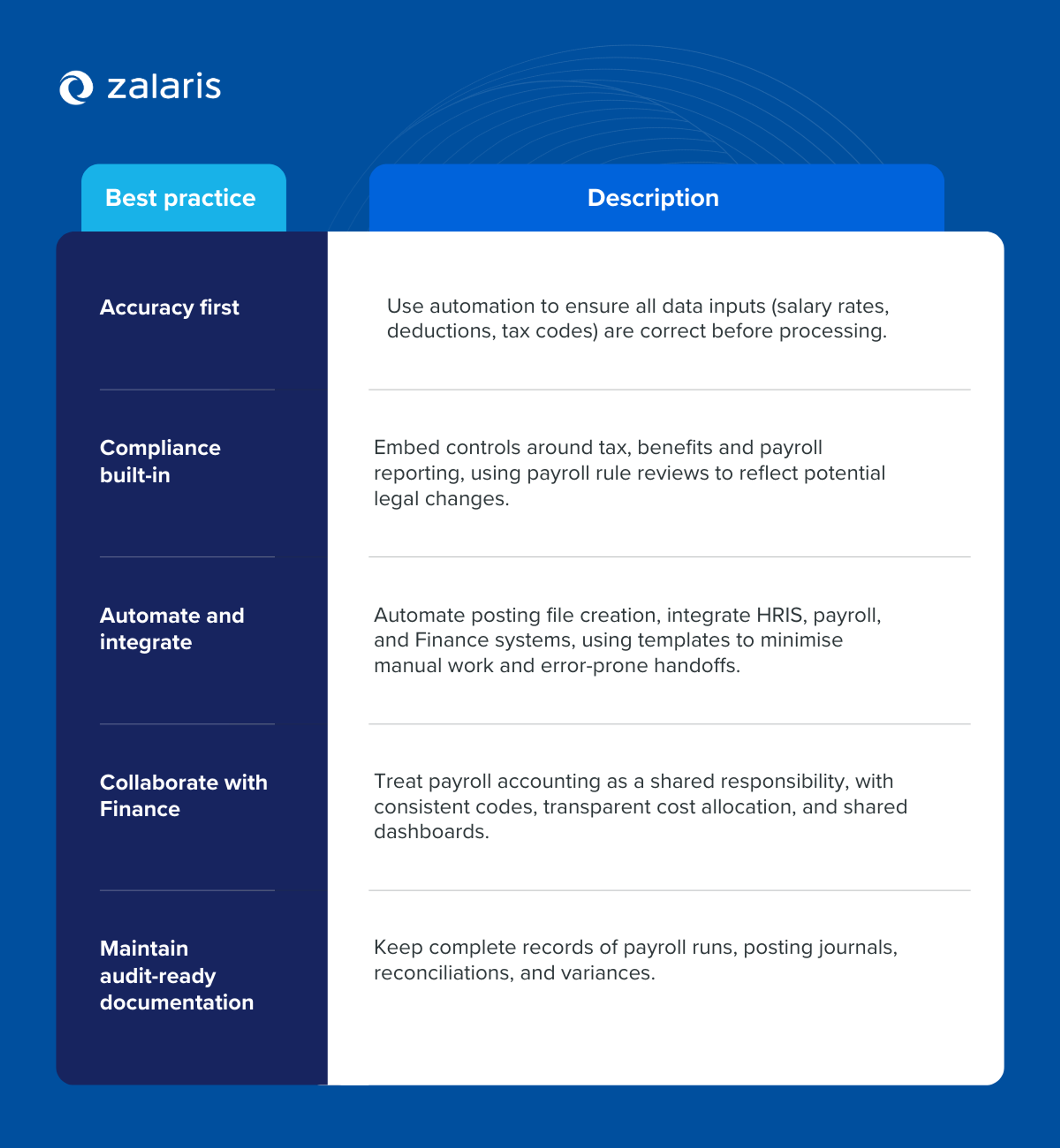
From best practices to real-world results
Comprehensive payroll accounting software, such as Zalaris PeopleHub, embeds the best practices into the wider payroll roadmap and helps organisations eliminate manual handoffs, reduce errors and maintain consistent, audit-ready payroll processes.
The Innomotics customer story shows how this works in practice. As part of its global transformation, the organisation selected Zalaris to implement PeopleHub and take over payroll accounting through a managed payroll model across more than 40 countries.
By integrating cloud technology together with managed payroll services provided by Zalaris, Innomotics didn’t just standardise payroll. They ensured streamlined payroll, time management, and travel/expense processes, and local compliance in over 20 countries.
This strengthened HR–Finance collaboration, improved operational efficiency, and created a scalable, future-ready payroll accounting framework that supports global growth and better decision-making.
Streamlining payroll accounting to strengthen HR–Finance alignment
Payroll accounting serves as a critical bridge between HR operations and Financial strategy. By defining a robust payroll accounting process for HR, organisations gain accuracy in cost reporting, insight into workforce expenses, and a foundation for better decision-making.
Specialist software strengthens this connection. Zalaris PeopleHub centralises payroll, HR, time, travel, and analytics into a single cloud platform. It supports self-service across devices and scales across over 150 countries while retaining local compliance, including UK-specific obligations such as PAYE and NIC.
To support deeper implementation and ongoing delivery, Zalaris also offers tailored payroll services. Partnering with Zalaris gives organisations proven technology, structured processes and expert management support, ensuring payroll accounting becomes a strategic asset. Contact the Zalaris team today and begin your journey to more efficient and compliant payroll accounting.
FAQ