



Between STP finalisation, payroll reconciliations, superannuation checks, reporting obligations and increased employee queries, there is very little room for error.
But EOFY is also more than a compliance deadline.
For many organisations running SAP Payroll, SAP HCM or Employee Central Payroll (ECP), it becomes a real-time test of payroll accuracy, operational resilience and system readiness.
It is often at this point that underlying issues become harder to ignore, with manual workarounds persisting alongside disconnected systems, reporting inconsistencies, and a heavy reliance on spreadsheets. These challenges are frequently compounded by increasing pressure on payroll resources, as well as noticeable gaps in governance and overall visibility.
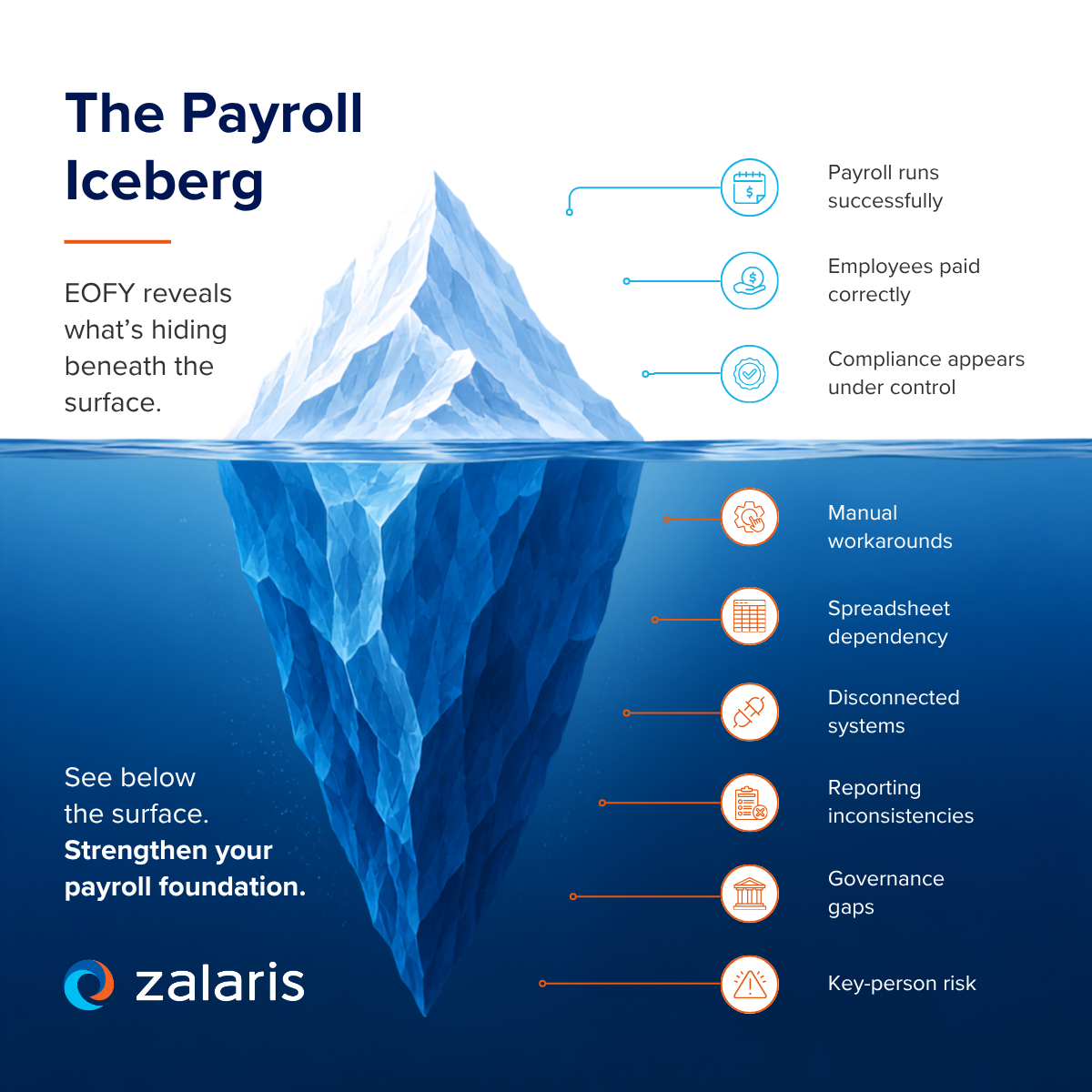
While payroll processes may function smoothly throughout the year, EOFY tends to expose where complexity, inefficiencies or operational risk are building beneath the surface.
And with future changes such as Payday Super approaching, many payroll leaders are starting to ask a bigger question:
“Is our payroll environment ready for what comes next?”
Why EOFY places payroll teams under pressure at the end of financial year
EOFY payroll processing requires payroll, HR and finance teams to work closely together under tight timeframes - while maintaining complete compliance and reporting accuracy.
For SAP payroll environments, EOFY activity commonly includes:
- STP finalisation
- Payroll reconciliation
- Superannuation validation
- Leave balance reviews
- Finance reporting alignment
- Audit preparation
- Employee payment queries
The challenge is not necessarily the tasks themselves. It is the complexity sitting behind them.
For organisations operating across multiple systems, legacy environments or manual payroll processes, EOFY can quickly become resource-intensive and difficult to manage.
This is especially common where teams rely heavily on:
- Spreadsheets and offline calculations
- Manual approvals
- Disconnected HR and payroll systems
- Heavily customised payroll configurations
- Key-person knowledge
These issues may remain manageable during standard payroll cycles, but EOFY often amplifies them.
What the latest payroll data tells us
Recent industry findings reinforce that many of the payroll pressures organisations experience during EOFY are not isolated issues, but part of broader operational trends.
According to the 2026 Payroll Industry Report, payroll risk is increasingly being driven not by payroll processing itself, but by poor upstream data, disconnected systems and governance gaps.
- 65.3% of payroll professionals identify poor or incomplete payroll data as a top operational risk
- 45.2% cite poor system integration as one of payroll’s biggest challenges
- 52.8% identify compliance risk as the biggest concern associated with Payday Super
These findings reinforce an important reality for payroll leaders: EOFY is often where hidden operational friction becomes more visible.
Issues such as disconnected systems, manual workarounds, reporting inconsistencies or payroll exceptions may remain manageable during standard payroll cycles, but year-end processing tends to amplify them.
At the same time, while more than 90% of organisations describe themselves as at least some what prepared for Payday Super, only a minority consider themselves very prepared - highlighting that significant work still remains around payroll processes, controls and payroll-super integration.
EOFY is no longer just a compliance event. For many organisations, it has become the clearest indicator of payroll maturity, operational resilience and readiness for future change.
EOFY myths vs facts: What payroll teams still get wrong
Despite increasing payroll complexity across Australia, there are still several common misconceptions around EOFY readiness.
| Myth | Reality |
|---|---|
| If payroll ran successfully all year, EOFY should be straightforward. | EOFY often exposes reconciliation gaps and reporting inconsistencies that are not visible during standard pay runs. |
| STP compliance means payroll data is accurate. | STP reporting does not automatically eliminate payroll data quality or reconciliation issues. |
| Manual payroll workarounds are manageable. | EOFY volume and reporting pressure significantly increase the risk of manual error. |
| Legacy payroll environments are stable because they’re familiar. | Familiarity can mask inefficiencies, scalability concerns and operational overhead. |
| Payday Super readiness is still a future problem. | Many organisations will need significant payroll process and systems preparation well before obligations take effect. |
Practical EOFY payroll readiness actions
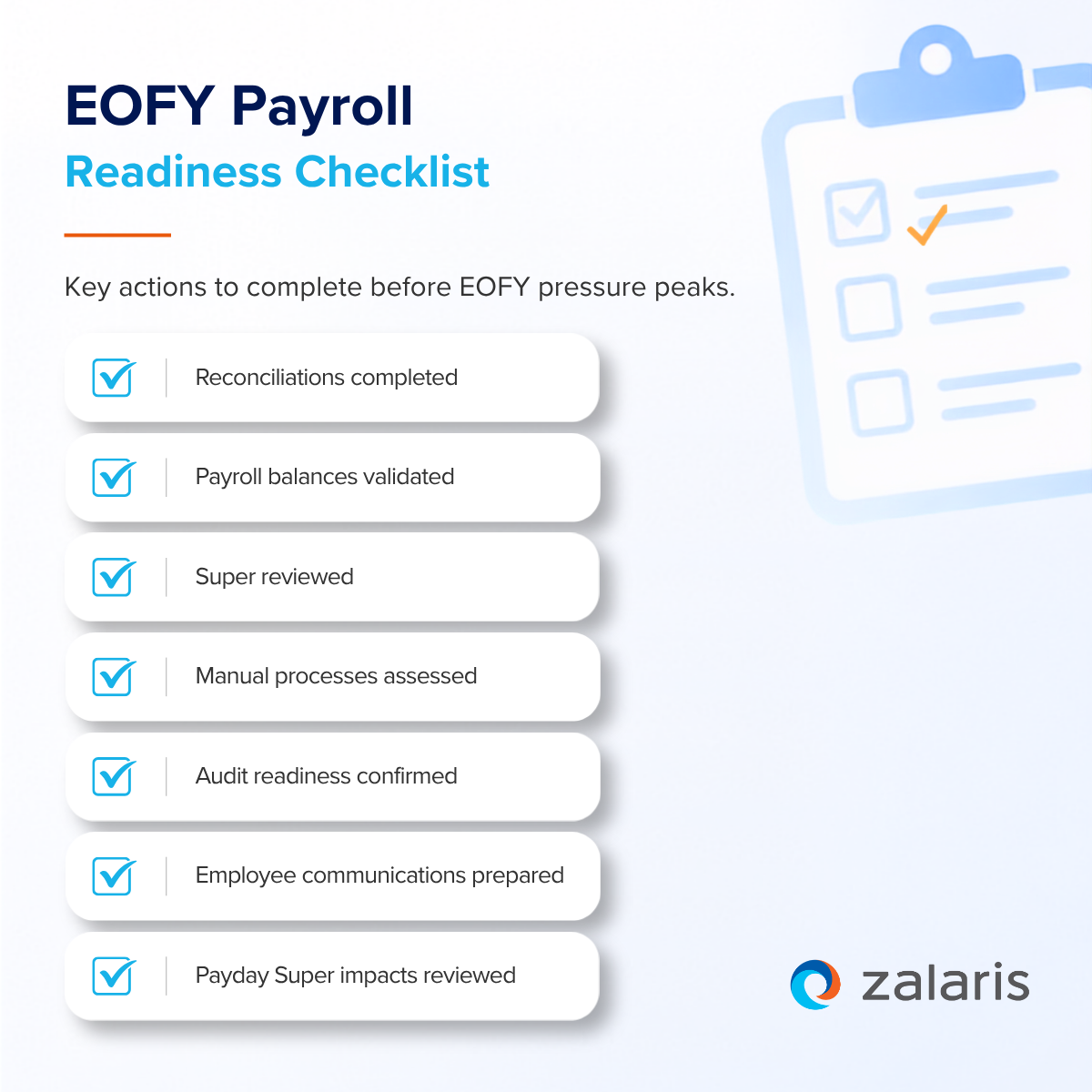
While every payroll environment is different, there are several practical areas payroll leaders should review before EOFY pressure peaks.
Start reconciliations early
Leaving reconciliations until EOFY can create unnecessary pressure and increase the likelihood of issues being identified too late to resolve efficiently.
Payroll teams should validate key areas such as:
- Payroll balances
- Tax calculations
- Superannuation reporting
- Wage type accuracy
- Finance alignment
Validation and reconciliation activities should be undertaken periodically throughout the financial year rather than being concentrated at the end of the financial year (EOFY). This aligns with one of the key principles of the Single Touch Payroll (STP) framework, which was introduced to replace the previous reporting process. By facilitating ongoing validation and reconciliation, STP promotes the timely identification and resolution of discrepancies, reduces EOFY processing effort, and enhances the accuracy and integrity of payroll reporting.
Organisations that adopt a continuous reconciliation approach are generally better positioned to identify discrepancies early, reduce EOFY workload and maintain higher levels of payroll data integrity.
Review manual payroll processes
EOFY often exposes where payroll operations rely too heavily on manual effort.
This may include:
- Spreadsheet-based reconciliations
- Offline approvals
- Duplicate reporting
- Manual data handling
- Reliance on key payroll personnel
Reducing manual processes can improve accuracy, governance and operational efficiency over time.
Assess reporting and audit readiness
As compliance expectations continue to grow, payroll reporting and audit readiness remain critical.
Payroll teams should ensure:
- Reporting is accurate and consistent
- Audit trails are clear
- Payroll records are accessible
- HR, payroll and finance reporting aligns
This is especially important in complex or hybrid SAP payroll environments.
Prepare for increased employee queries
Employee payroll enquiries often increase significantly during EOFY, particularly around:
- Tax
- Superannuation
- Leave balances
- Payment summaries
Clear communication and accessible payroll information can help reduce pressure on payroll teams during peak periods.
EOFY can also reveal broader payroll transformation needs
For some organisations, EOFY becomes a natural checkpoint to assess whether their current payroll environment is still fit for purpose -not just for today's requirements, but for future business and compliance demands.
This is particularly relevant for organisations operating:
- Legacy SAP HCM environments
- Hybrid payroll models
- Highly customised payroll systems
- Fragmented HR and payroll landscapes
As compliance obligations evolve and payroll complexity increases, many organisations are reassessing their operational sustainability, reporting capability, system integration, automation opportunities, and long-term scalability.
This does not necessarily mean immediate transformation.
However, EOFY often provides the clearest visibility into where payroll processes may be creating unnecessary operational effort or future risk.

Looking ahead: Payday Super and future payroll readiness
Upcoming Payday Super requirements are also accelerating conversations around payroll readiness across Australia.
For many organisations, future compliance expectations will require:
- Stronger payroll governance
- Improved payroll accuracy
- Faster processing cycles
- Better integration between systems
- Reduced manual intervention
As a result, EOFY is increasingly becoming more than a year-end compliance exercise.
It is becoming a strategic opportunity to assess whether payroll operations are equipped to support future business and compliance demands.
Is your payroll environment ready for what comes next?
EOFY will always put payroll operations under pressure - but it can also provide valuable visibility into how sustainable, efficient and future-ready payroll processes really are.
For organisations running SAP Payroll, SAP HCM or Employee Central Payroll, EOFY is more than a year-end compliance exercise. It is an opportunity to identify operational gaps, reduce manual complexity and strengthen payroll readiness for the future.
And with increasing compliance expectations, growing workforce complexity and upcoming changes such as Payday Super, these conversations are only becoming more important.
The organisations that approach EOFY proactively - rather than simply aiming to get through it - are often the ones best positioned to improve payroll resilience, governance and long-term operational efficiency.
Whether your organisation is preparing for EOFY, reviewing payroll processes, or starting to think about Payday Super readiness, taking a proactive approach now can help reduce risk and improve operational confidence later.
Zalaris can help organisations assess payroll readiness, reduce operational complexity and prepare for the future of payroll in Australia. Get in touch with our experts today!
FAQ

Joseph Cachapero
Managed Payroll Manager
Joseph Cachapero is a Managed Payroll Manager at Zalaris APAC with over 19 years of experience in payroll operations, managed services, and HR technology across the Asia-Pacific region. He specialises in payroll transformation, service delivery, and operational excellence, helping organisations simplify complexity, ensure compliance, and build efficient payroll processes that support long-term business success.