


Today’s HR leaders are navigating unprecedented complexity and a rapidly changing business landscape while trying to reduce costs and drive growth. While HR professionals spend up to 57% of their time on administrative tasks, HR is incresingly expected to champion strategic priorities including employee development, culture, AI adoption and change management.
Common pressure points include:
- Digital transformation: As more organisations shift to cloud-based solutions, HR teams are under pressure to quickly redesign processes, optimise systems and facilitate change management.
- Cross-border compliance complexity: Multinational organisations face an increasingly complex web of local employment regulations, data privacy laws, and tax codes.
- Rise of flexible work models: Hybrid and remote work arrangements demand more agile processes for onboarding, engagement, and performance management.
- Strategic positioning of HR: There’s a growing expectation for HR to deliver business value as a strategic function beyond compliance and administration.
To remain effective and resilient, HR teams must transform challenges into opportunities for excellence. The following trends illustrate how that transformation is unfolding – and why HR as a Service is becoming the preferred model.
Key trends shaping HR teams in 2026
Forward-thinking organisations are embracing digital-first, employee-centric approaches to boost efficiency, agility, and experience. Here are the most impactful trends reshaping modern HR:
1. Cloud-based HR and payroll systems for seamless compliance
Global compliance has become more complex as labour laws and payroll regulations evolve rapidly. In just 2026, regulations such as the EU Pay Transparency Directive and the UK’s Employment Rights Act are increasing compliance burdens.
According to a study by PayrollOrg, 57% of organisations identified ensuring local compliance as their single biggest challenge - and only 28% of businesses have a formalised global payroll strategy in place, while 42% have not started developing one at all.
Cloud-native HR platforms are now central to staying compliant. With features like automatic legal updates, localised configurations, and real-time reporting, these systems reduce risks and eliminate data siloes. Integrated payroll, time, talent, and core HR administration further drive process efficiency and centralised control – freeing HR teams from reactive compliance management, and allowing time and resources to prioritise strategic priorities.
For organisations operating across borders, a unified data model with embedded compliance is no longer a “nice to have” - it is the operational foundation that makes everything else possible.
2. Employee experience as a strategic priority
Today, HR is expected to deliver a consumer-grade experience that drives engagement, performance, and retention.However, boosting employee engagement has never been harder. Employees are fatigued by increasing change, AI outpacing learning, and threats to job security. Gallup's 2026 State of the Global Workplace report found that global employee engagement fell to 20% in 2025, its lowest level since 2020.
HR has a big role to play in shaping people and culture sentiments – a role that is often sidelined due to overwhelming operational demands.
Leading organisations are deploying:
- Personalised onboarding that reflects the organisation’s culture and values from day one
- Intuitive, consistent learning journeys that support continuous development
- Standardised global processes with room for meaningful local adaptation
- Digital-first employee interactions across geographies and time zones
Organisations that invest in consistent employee experiences report measurable improvements in retention, engagement scores, and manager effectiveness. A standardised global approach with local flexibility empowers HR to focus on culture and strategy, not administrative exceptions.
3. Strategic HR partnerships
HR is increasingly recognised as a strategic enabler, not just a support function. Organisations with well-integrated HR partnerships report 22% higher employee performance - and that gap is widening as the complexity of managing people, technology, and compliance continues to grow.
Modern HR outsourcing has evolved beyond transactional support.
Today’s strategic HR partners bring advisory depth, digital expertise, and embedded operational capability:
- Access to specialists in transformation, digital enablement, and cross-border compliance
- HR Business Partner support - on demand, without the cost of permanent headcount
- Governance and regulatory expertise deployed where and when you need it
- Workforce planning and organisational design capability aligned to business strategy
Choosing the right HR partner means freeing your internal teams to focus on innovation and business impact, while benefiting from best-in-class expertise across every aspect of the HR function.
4. Intelligent automation and AI adoption
AI is reshaping HR - and the pace of adoption is accelerating. According to SHRM's survey of 1,908 HR professionals in December 2025, 39% currently have AI adopted in their HR functions, and 62% are currently using AI somewhere in their organisation. In 2026, when 46% of organisations expect to use AI in HR, the question is no longer whether to adopt AI, but how to do so at scale while maintaining accuracy, compliance, and a human-led service ethos.
AI applications with measurable impact include:
- Chatbots and self-service portals that resolve employee queries without HR intervention
- Automated screening and candidate matching in talent acquisition
- Predictive analytics that identify retention risks and workforce gaps before they become problems
- Payroll accuracy checks and real-time anomaly detection across multiple countries
- Skills intelligence that supports dynamic workforce planning and learning prioritisation
With intelligent automation, HR teams can operate at scale, reduce manual errors, and refocus human effort on the strategic decisions that require judgement, empathy, and expertise.
5. HR analytics and data-driven decision making
Data analytics is driving smarter, more proactive HR. 76% of organisations now have some form of HR analytics in place, though only 6% have reached predictive maturity - and organisations tracking 15 or more HR metrics show 23% better business outcomes. Organisations now use people analytics to inform strategy - and those that do are making faster, better-evidenced decisions on everything from workforce planning to compensation benchmarking.
Key capabilities enabling this shift include:
- Identifying skill gaps and retention risks before they surface as vacancies or attrition
- Forecasting hiring needs aligned with business growth plans and budget cycles
- Evaluating performance and compensation trends across geographies and functions
- Ensuring global payroll accuracy and consistency through unified reporting
- Providing HR leadership with real-time insights into organisational performance and risks
Analytics enables HR to move from reactive to proactive - from reporting on what happened to advising on what to do next. This is the shift that transforms HR from cost centre to strategic value driver.
| Trend | Business Impact |
|---|---|
| Cloud-based HR and payroll | Real-time compliance and global scalability |
| Unified employee experience | Increased retention, engagement, and manager effectiveness |
| Strategic HR partnerships | Efficiency, expert-led transformation, and reduced overhead |
| AI and intelligent automation | Cost optimisation, operational agility, and fewer errors |
| People analytics | Proactive workforce planning and evidence-based HR leadership |
Why businesses are embracing HR as a Service
Today’s organisations need more than fragmented providers or inflexible systems. They require a single strategic partner who delivers compliant operations, strategic insights, and scalable services - all under one roof.
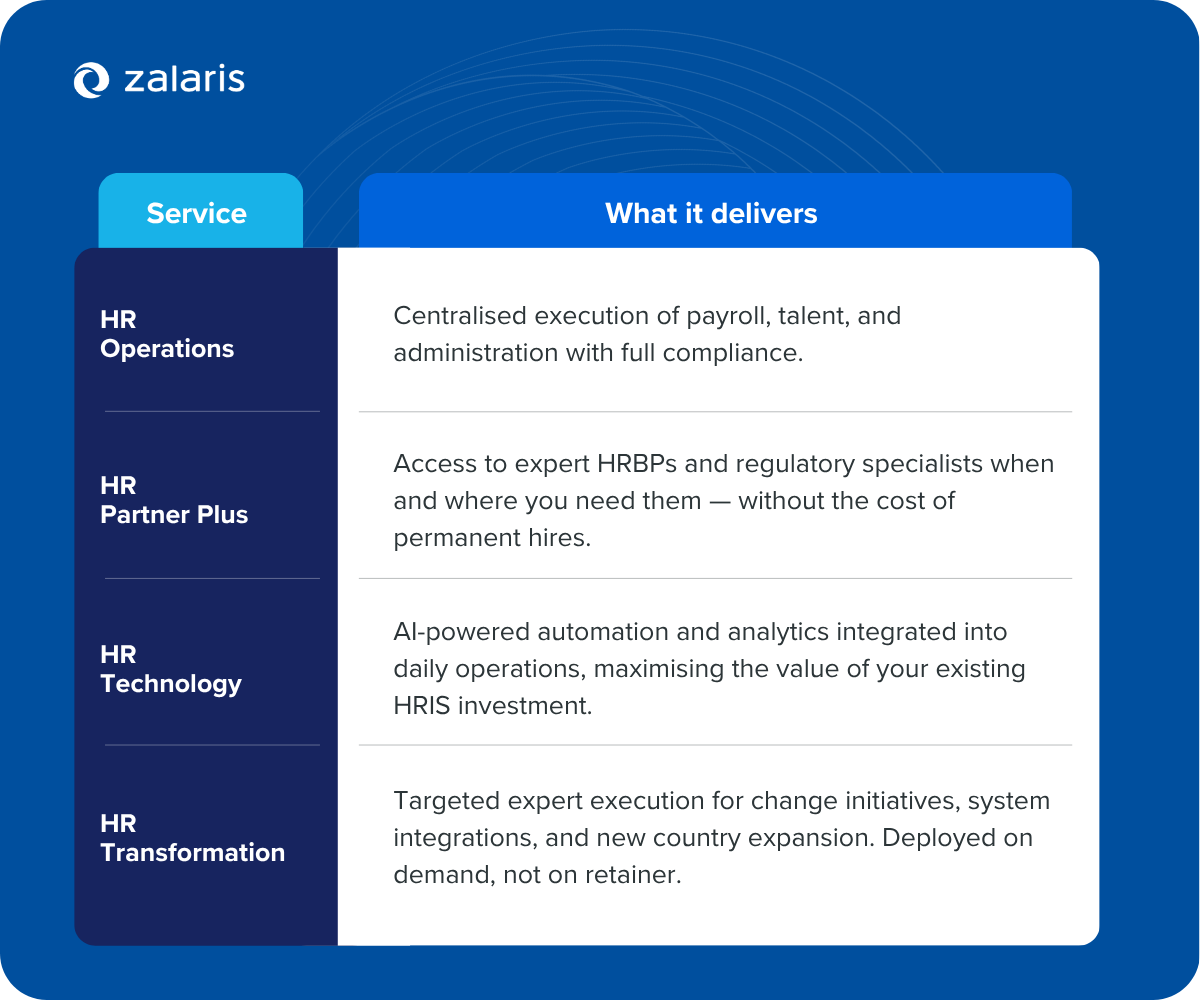
Zalaris’ HR as a Service model was built for this reality. It is an integrated operating model where reliable HR and payroll operations run seamlessly in the background, freeing your HR team to focus on what drives real business value. Built on a dual delivery model - Business-as-Usual (BAU) operations and on-demand Consulting - it offers modular, expert-led support across four key services:
HR Operations
A centralised, multi-country HR operations hub that manages high-volume HR tasks with precision and efficiency. End-to-end HR administration across the full employee lifecycle, delivered to agreed SLAs with 24/7 coverage and dedicated teams. With integrated payroll at its core, there is one provider, one data model, and one point of accountability.
HR Partner Plus
On-demand access to experienced HR Business Partners, regulatory specialists, and governance experts - without the cost and commitment of permanent headcount. Whether you are navigating a transformation programme, managing compliance requirements, or addressing day-to-day strategic HR decisions, support scales to match your requirements.
HR Technology
Smart services that amplify your existing technology investment. Zalaris works with your current HRIS landscape - SAP SuccessFactors, Workday, or any other third-party platform - adding the operational layer, automation, and analytics integration that makes the technology actually deliver its promise. Your HRIS moves from a data repository to a functional base for AI-enabled processes and real-time workforce insights.
HR Transformation
Targeted expertise for specific HR challenges and initiatives. Project-based or ongoing advisory that deploys when you need it and scales as your needs change. From system integrations and change management to process optimisation and new country expansion, specialist support is available for the full scope of HR transformation.
Zalaris HR as a Service: Powered by smart services & technology
As HR becomes more complex and business-critical, organisations need support models that are agile, scalable, and built for the future. Zalaris’ HR as a Service delivers just that, enabling you to:
- Simplify HR operations with one integrated partner and a single point of accountability
- Deliver seamless HR digital transformation without operational disruption
- Ensure compliance and accuracy across all geographies with embedded regulatory expertise
- Unlock the full value of your HRIS with AI-enabled automation and real-time people analytics
- Prepare your organisation for the future of work - without increasing permanent headcount
Ready to redefine your HR function for the future?
Contact us to learn more about how Zalaris’ HR as a Service can support your organisation’s HR transformation journey.
FAQ

Elliot Raba
Enterprise Sales Executive
Elliot is a dynamic and results-driven Enterprise Sales Executive at Zalaris UK&I, where he excels in crafting innovative solutions that address the unique needs of his clients. With a keen understanding of the intricacies of enterprise level operations, Elliot leverages his extensive industry knowledge to drive business growth and foster lasting partnerships.