
 Back to Blogs
Automated employee onboarding: contract-to-payroll integration
Manual onboarding of an employee slows new hires down. Fragmentation quickly affects payroll accuracy, compliance, financial reporting, and productivity. The solution is to connect all the elements together with an automated onboarding process.
Elliot Raba
03.06.2026 · 6 min read



Modern workforce strategy demands an onboarding process that functions like clockwork. Organisations recruit across borders, integrate remote and hybrid employees into teams, and manage payroll across multiple currencies and entities. Employee onboarding now triggers payroll configuration, tax logic, cost allocation, system access, and compliance documentation through employee onboarding automation.
Errors in this process spell disaster. They quickly cascade into payroll adjustments, compliance gaps, and month-end reconciliation work. Manual handovers increase these risks, whilst automated onboarding turns onboarding tasks into a governed workflow that integrates with multiple systems, reducing errors and improving new hire retention. By implementing onboarding automation, organisations can streamline the employee journey from recruitment to payroll, enhancing accuracy and compliance with minimal human intervention.
The importance of automated employee onboarding in modern organisations
Research published in the International Journal of Research and Analytical Reviews found that effective onboarding not only reduced early turnover but was also associated with higher job satisfaction among employees. Whilst onboarding plays this crucial role in retaining workers, it now serves a deeper role as a financial and compliance trigger.
It determines how salary flows into payroll, how costs map to finance, and how statutory data is recorded. In multi-entity environments, it also affects currency alignment and consolidation accuracy.
How manual onboarding manifests in real operations
A common onboarding scenario sees HR capture the initial employee information but payroll then re-entering specific salary and tax details. Finance teams continue to make adjustments to cost calculations, while IT provisions system access and manages user accounts. This reveals the friction that quickly builds up in traditional onboarding processes.
The result leaves compliance, onboarding, and payroll data residing in shared spaces. But, crucially, with no meaningful communication or automated workflows coordinating them. This leads to conflicting employee records, payment delays, and limited analysis of onboarding performance, undermining onboarding automation success.
As the Bank of England governor has warned, these administrative inefficiencies lead to measurable productivity loss across professional sectors. Simply put, fragmented onboarding contributes directly to that inefficiency at scale, increasing manual processes and repetitive administrative tasks that reduce employee productivity and overall hire retention.
Basic HR systems vs fully integrated processes
Assuming that implementing an HR system solves onboarding challenges overlooks important limitations: Basic systems primarily store employee data and often lack true workflow orchestration across payroll, finance, and compliance. As a result, onboarding remains a sequence of disconnected actions rather than an end-to-end lifecycle workflow.
On the other side, an automated onboarding process creates an end-to-end workflow from contract to payroll. A fully integrated model offers:
- Rule-based digital contract generation
- Embedded compliance validation aligned with local labour law
- Structured HR master data capture
- Direct payroll system integration and finance system synchronisation
- Audit trails and reporting dashboards
- Currency and tax configuration for cross-border hires
This important integration elevates onboarding from transactional administration to enterprise control architecture.
A side-by-side comparison
| Basic HR software | A fully integrated software |
|---|---|
| Automatic payroll configuration | Feeds contract data directly into payroll |
| Validation of country-specific tax rules before onboarding | Aligns salary currency with exchange-rate logic |
| Real-time cost and payroll calculations around currencies | Synchronises costs and benefits with finance systems in real time |
| Reporting alignment with finance | Operates HR, payroll, and finance on a single validated dataset |
Why multi-currency teams raise the stakes
Multi-currency environments amplify complexity. Each new hire requires local statutory tax configuration and payroll data in local currency. Onboarding must also deal with country-specific compliance documentation. With automated onboarding systems, salary currency, taxes, and cost allocations align from day one.
Choosing the right employee onboarding solutions
Selecting employee onboarding solutions requires evaluating complexity, system integrations, and governance. Organisations should prioritise seamless integration with ATS and HRIS for smooth data flow in recruitment and onboarding. The solution must automate workflows for documents, benefits, and compliance, reducing manual errors. It should support self-service tools for new hires and managers, and enable feedback gathering.
Considering AI-powered platforms can personalise onboarding, enhance communication, and boost retention. Solutions aligned with company culture and offering reporting dashboards help HR monitor and optimise onboarding performance.
Key criteria for choosing solutions for onboarding: Checklist
1. Integration architecture
The software integrates natively with payroll, finance, and identity management systems.
Checklist:
- Request proof of native integration rather than manual data exports
- Review architecture diagrams
- Validate real-time synchronisation capability
2. Multi-country compliance configuration
Localisation, statutory rule engines, and configurable contract templates to support global hiring.
Checklist:
- Review country-specific configuration examples
- Assess how updates to legislation are managed
- Confirm audit trail functionality
3. Workflow governance and configurability
Supports entity-specific approval flows, conditional logic, and segregation of duties.
Checklist:
- Test scenario-based workflows
- Assess role-based permission structures
4. Data governance and auditability
Compliance architecture benefits from clear audit trails, GDPR alignment, and secure document management.
Checklist:
- Examine reporting dashboards
- Review data retention configuration
5. Multi-currency payroll alignment
Salary structures, allowances, and deductions synchronise automatically with payroll and accounting systems without recalculation.
Checklist:
- Confirm exchange-rate feed automation
- Validate cost centre mapping logic
6. Implementation expertise and service capability
Software provided alongside payroll advisory expertise, integration experience, and structured implementation.
Checklist:
- Ask for support details and channels
Reducing conflicts with best practices
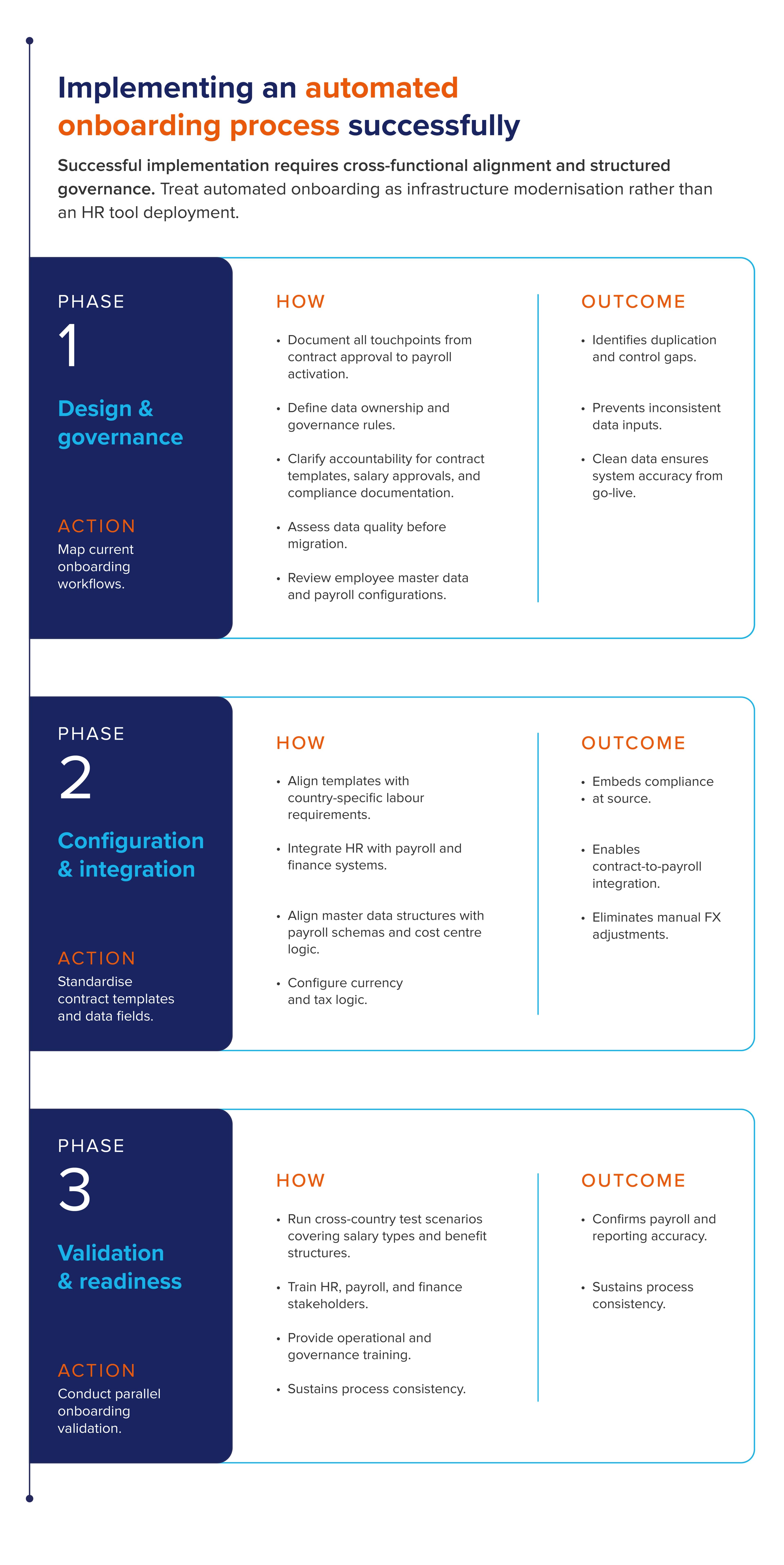
Effective implementation requires joint ownership from HR, payroll, finance, IT, and legal teams. Organisations typically measure onboarding performance through operational KPIs such as first-payroll accuracy, contract-to-system activation time, payroll readiness before cutoff, and employee data correction rates. Implementing effective onboarding automation also reduces repetitive tasks and frees HR teams to focus on strategic initiatives like cultural integration and talent retention.
Monitoring these metrics during rollout and beyond ensures that onboarding workflows remain accurate, compliant, and fully aligned with payroll, finance, and existing systems. This approach limits over-customisation, clarifies accountability among the hiring manager, hr team, and payroll staff, and prevents unclean or inconsistent data from entering the system. Clear ownership and structured oversight reduce transformation risk, support workflow automation, and protect long-term process integrity for the entire process.

Automated onboarding is a non-negotiable for modern teams
First impressions matter, especially in the workplace. By opting for automated employee onboarding, organisations improve this interaction and strengthen enterprise data governance as a whole. An automated process connects contract generation, HR master data, payroll integration, and finance alignment into a unified process. For remote and multi-currency teams, this integration improves reporting accuracy, compliance assurance, and visibility into workforce costs.
Zalaris implements automated onboarding using solutions such as SAP SuccessFactors Onboarding and SAP SuccessFactors Employee Central Payroll, integrated with payroll and finance systems. Organisations gain a structured contract-to-payroll integration, supported by deep European payroll expertise and a governance-focused implementation.
Curious to see how your organisation can optimise its onboarding strategy? Arrange a strategic discussion with our team.
FAQ



Elliot Raba
Enterprise Sales Executive
Elliot is a dynamic and results-driven Enterprise Sales Executive at Zalaris UK&I, where he excels in crafting innovative solutions that address the unique needs of his clients. With a keen understanding of the intricacies of enterprise level operations, Elliot leverages his extensive industry knowledge to drive business growth and foster lasting partnerships.
Table of Contents
- The importance of automated employee onboarding in modern organisations
- How manual onboarding manifests in real operations
- Basic HR systems vs fully integrated processes
- Why multi-currency teams raise the stakes
- Choosing the right employee onboarding solutions
- Key criteria for choosing solutions for onboarding: Checklist
- Reducing conflicts with best practices
- Automated onboarding is a non-negotiable for modern teams