


At a glance
- 52% of UK HR functions are seen as delivering strategic value, despite a decade of investment (Sapient Insights, 2025-26)
- 4.5x more likely to see positive AI outcomes with strong operating-model readiness (i4cp)
- £2.78bn forecast size of the UK HR technology market in 2026 (Fortune Business Insights)
Why the gap exists
UK organisations lead HR technology procurement. Cloud HCM suites, workforce analytics, employee experience platforms and now AI tools have modernised almost every corner of the function, and the UK HR technology market alone is on track to reach £2.78 billion this year. The value coming back, however, hasn't kept pace.
That gap has a specific cause: not the technology, but the way it's run. The businesses getting a lasting return aren't the ones that spent the most or bought the newest platform. They're the ones that treated go-live as the start of the work, not the end of it.
Spending was never the problem
Multiple data points confirm that funding isn't in short supply. UK HR and payroll technology spend continues to grow year on year, and most medium-to-large UK organisations are already running sophisticated, multi-system HR environments. Converting that investment into value that lasts is the harder, unfinished part.
HR is being asked to do more, with the same base
Only 52% of UK HR functions are seen as delivering strategic value (Sapient Insights, 2025-26). Globally, employee engagement sits at 20% (Gallup), a roughly $10 trillion annual hit to productivity, not an HR problem alone but a measure of how much is now expected of the function. Gartner's research backs this up: evolving the HR operating model has a bigger predicted impact on productivity than most technology or training initiatives.
CIPD's evidence review points to why: organisations that treat transformation as a project with an end date, rather than embedding new ways of working into daily operations, see the return fade once the implementation team disbands.
Readiness beats better tools
i4cp research shows organisations with strong operating-model readiness were 4.5 times more likely to see positive outcomes from AI investment than those without. Readiness means the operating model is in place before the technology arrives: a culture that values evidence over instinct, leadership that treats the initiative as a business priority rather than an IT project, governance clear enough that someone owns the outcome and a workforce with the skills to work differently once the system goes live.
The Hackett Group's benchmarking puts a number on what that discipline is worth: leading HR organisations serve 165 employees per HR professional against an index of 100 for everyone else, at 56% of the labour cost per employee served. Same category of technology, wildly different results.
Fragmentation is the UK's sharper version of the problem
Most mid-to-large UK organisations now run a stack of HCM, payroll, workforce management, experience and analytics tools, each one a sensible purchase on its own. Alex Hanson-Smith, co-founder of HR tech company inploi, describes the resulting market as 'mature but highly fragmented': a patchwork stitched together over a decade of individually rational decisions.
That fragmentation rarely shows up as a line item, which is why it survives unchallenged. It shows up as a payroll query that takes three handoffs to resolve, a workforce report that needs manual reconciliation because two systems define headcount differently, an AI pilot that stalls because the data it needs sits in two platforms at once.
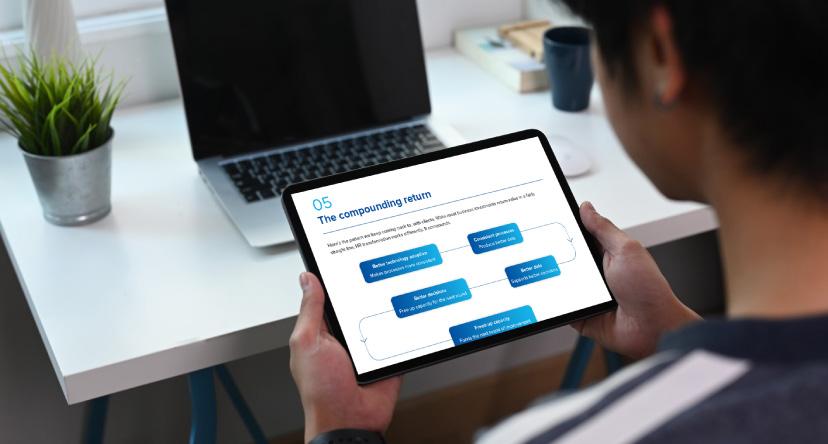
5. The return compounds, or it stalls
Most business investments return value in a fairly straight line. HR transformation works differently: it compounds, or it stalls, depending on what happens after go-live. The full briefing maps out exactly how that compounding effect builds, and the specific points where it typically breaks down.
Three checks before you commit
Based on the pattern we keep seeing, three questions are worth putting to any HR transformation business case before it's signed off. The full briefing sets out what to look for under each one.
- Name the outcome, with a number attached.
- Ask who owns it 18 months from now.
- Track the metrics continuously, not just at go-live.
We see that gap constantly in the UK market. The technology stack rarely explains why one organisation pulls ahead of another, the operating model around it tells a different story.
FAQ

Stephen Burr
EVP & Managing Director, Zalaris UK & Ireland