

Payroll is one of those things that, when it runs smoothly, nobody notices. Organisations still need to pay employees accurately and on time while managing tax compliance, reporting and employee trust.
For organisations reviewing how payroll should be run, the real question is not which model sounds best in theory. It is which payroll operating model best fits internal capabilities, compliance complexity and the level of control the organisation wants to maintain.
Key takeaways
- In-house, Managed Payroll and Hybrid are the three core payroll operating models.
- In-house offers the most direct control but requires strong internal expertise and capacity.
- Managed Payroll transfers greater operational responsibility to a specialist provider.
- Hybrid combines internal ownership with external delivery for selected activities.
- For global payroll, the right answer may be a combination of models across different countries within one overall payroll strategy.
Three payroll operating models: an overview
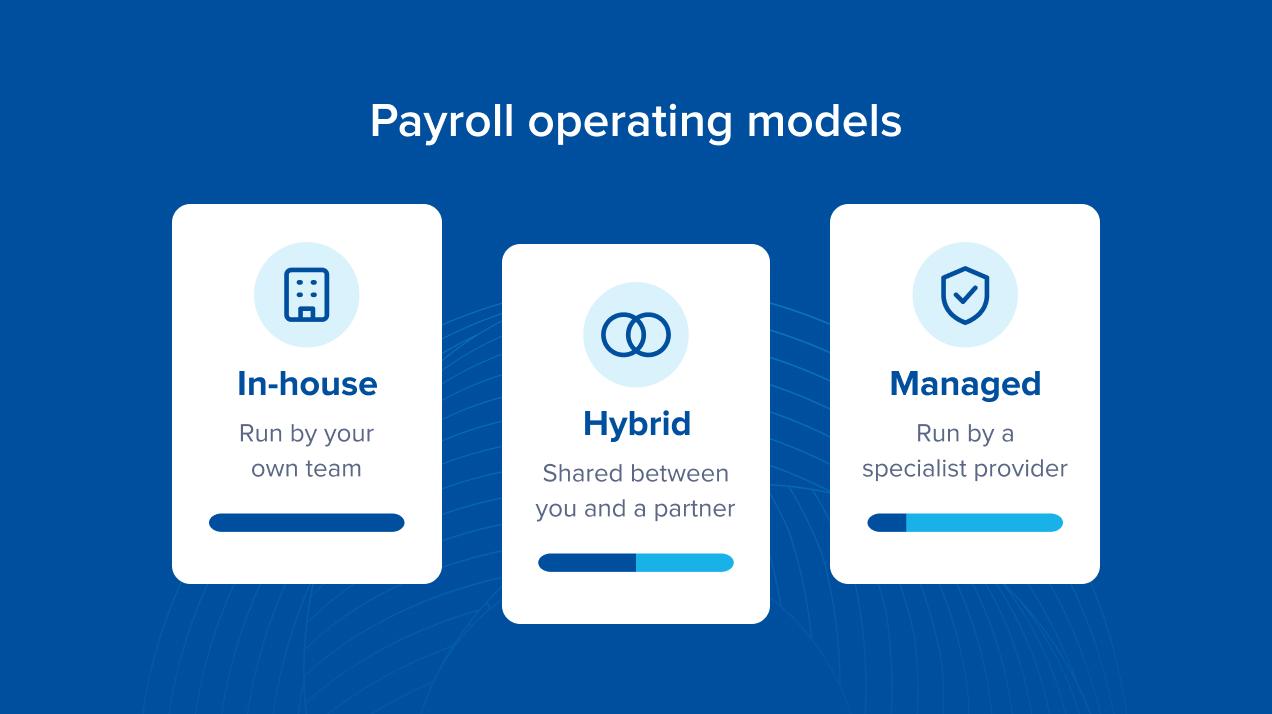
The three main payroll operating models are In-house, Managed Payroll and Hybrid. Each creates a different balance between internal control, specialist support and operational responsibility.
In-house payroll
In-house payroll means the organisation runs payroll internally using its own people, processes and payroll tools. Internal payroll professionals manage calculations, statutory deductions, data validation, tax filings, reporting and employee queries.
This model provides direct control over payroll operations and data. It can work particularly well where the organisation has mature payroll capability, reliable payroll software and sufficient local expertise.
Managed Payroll
Managed Payroll moves greater responsibility for payroll operations to a specialist provider. Depending on the service scope, the provider can manage payroll processing, legislative updates, filings, reporting and employee payroll queries under agreed service levels.
The organisation retains governance and oversight, while the provider takes responsibility for the agreed operational activities.
Hybrid payroll
Hybrid payroll combines in-house ownership with external delivery. The organisation retains selected activities, such as data ownership, approvals, governance or employee relations, while a provider supports processing, calculations or country-specific compliance activities.
This creates a flexible model for organisations that want to retain particular payroll capabilities internally while accessing specialist support where it adds value.
In-house, Managed Payroll and Hybrid: pros, cons and decision triggers
Choosing the right payroll operating model is a practical decision about risk, capacity, accountability, cost and control. The right balance will depend on the organisation’s payroll needs, internal capability and wider business strategy.
In-house payroll: best for control and close process ownership
In-house payroll gives strong control over process design, internal escalation and reporting logic. Payroll teams can move quickly when HR needs same-day checks, finance needs tailored outputs or senior leaders need direct access to payroll data.
It fits organisations with mature internal payroll capability. If the payroll team understands local legislation, manages deadlines effectively and uses reliable software, in-house payroll can be highly effective.
The pressure point is resilience and knowledge. Internal teams carry the full workload, and the model depends on specialist knowledge staying in the business. Peak periods, acquisitions, regulatory changes and absence cover can expose that quickly.
Choose In-house payroll when:
- Maximum control is a priority
- Payroll expertise already exists internally
- The organisation has the technology and capacity to manage payroll over time
Managed Payroll: best for specialist support, accountability and scale
Managed Payroll can be effective when payroll complexity outpaces internal capabilities. It can reduce manual workload, improve continuity and provide access to local experts who track legislation, reporting requirements and country-specific processes.
It can suit organisations expanding into new markets, consolidating fragmented payroll operations or reducing reliance on key personnel. The main consideration is governance: moving operational responsibility to a provider does not remove the organisation’s need for clear data, approvals and oversight.
Choose Managed Payroll when:
- Internal payroll capacity is stretched
- Compliance complexity is increasing
- The organisation needs scalable access to payroll expertise and operations
Hybrid payroll: best for flexibility
Hybrid payroll offers more flexibility than a simple choice between keeping everything in-house and moving everything to a provider. It allows internal teams to retain the capabilities they value while handing selected operational or specialist work to an external partner.
The challenge is role clarity. Hybrid works best when responsibilities are explicit: who owns payroll data, who validates calculations, who signs off the pay run, who handles employee queries and who manages statutory updates.
Choose Hybrid payroll when:
- The organisation wants to retain control over selected payroll activities.
- Strong internal expertise already exists in some areas.
- Additional processing, compliance or scale support is required.
How multi-country payroll changes the operating model decision
Running payroll across multiple countries introduces another level of complexity. Expansion often happens country by country: a business enters a new market and selects a local provider, inherits a payroll system through an acquisition or builds a different process around local requirements.
Over time, multinational companies can find themselves managing multiple vendors, contracts, payroll systems, data formats and operating models. Each arrangement may work locally, but collectively the structure can become difficult and costly to manage.
Different countries also bring different tax rules, reporting obligations, employment requirements and payroll practices. Local payroll expertise remains essential. But when every country is managed separately, organisations can face duplicated effort, inconsistent reporting, fragmented payroll data and limited visibility across global payroll operations.
Managing multiple vendors can add further handovers and points of accountability. Payroll, HR and finance teams may spend increasing amounts of time coordinating providers and reconciling information instead of improving payroll operations.
The question for a multinational organisation is therefore not simply whether payroll should be In-house, Hybrid or Managed. It is how the local payroll model in each country fits into one global payroll strategy.
One global payroll strategy does not require one model everywhere
A global payroll operating model does not mean forcing every country into exactly the same way of working. Local requirements still matter.
An organisation may retain payroll In-house where it has established technology and strong internal capability, use Hybrid delivery where additional specialist support is required, and choose Managed Payroll in markets where maintaining local payroll operations internally would prove costly or introduce unnecessary complexity.
The opportunity is to bring those choices into a more consistent global structure. Instead of adding another isolated payroll arrangement every time the organisation enters a new country, businesses can consider how technology, processes, service levels, payroll data and accountability should work across the wider organisation.
This can provide centralised oversight while retaining in-country expertise. Standardisation does not mean ignoring local requirements. It means creating greater consistency around how those requirements are managed.
What should you consider when choosing a payroll operating model?
The decision should start with what the organisation needs from payroll rather than with a predetermined preference for In-house, Hybrid or Managed delivery.
- Control: Which payroll responsibilities genuinely need to remain inside the organisation?
- Capability: Do internal payroll teams have the skills and capacity required now and in the future?
- Compliance: How will the organisation maintain access to local experts and respond to international payroll regulations and regulatory changes?
- Technology: Do existing payroll systems support efficient operations, integration and automation?
- Data: Can payroll data be accessed and reported consistently across the organisation?
- Cost: What is the full cost of internal resources, technology, providers and ongoing change?
- Scalability: How easily can the model support new employees, acquisitions and new countries?
- Governance: Is accountability clear across internal teams and payroll providers?
- Employee experience: Can the model consistently support accurate and timely payroll across the workforce?
Run Payroll on your terms
The right answer depends on organisational size, payroll complexity, internal capability and compliance exposure. Some organisations gain the most value from In-house payroll because control and internal knowledge are already strong. Others benefit from Managed Payroll because specialist support, accountability and process resilience matter more than direct operational ownership. For others, Hybrid provides the right balance.
For global organisations, the future model may combine all three. Zalaris supports In-house, Hybrid and Managed Payroll across a multi-country environment, allowing organisations to choose how payroll is run based on their requirements in each market while creating greater consistency across global payroll operations.
With one data model, one point of accountability and consistent SLAs across countries, organisations can simplify the provider landscape while retaining in-country expertise. Certified integrations with SAP SuccessFactors, Workday, Oracle and HiBob support payroll alongside the organisation’s wider HR technology landscape.
Choose how you run payroll. Keep the flexibility to change. Get in touch to explore the right payroll model for you.