


For decades, payroll ran quietly in the background of the business.
Nobody praised it when it worked, and everybody noticed the moment it did not. The perception of payroll as a purely operational function is starting to shift - tightening regulation, rising employee expectations, and a wave of AI-enabled technology is putting pressure on businesses to transform payroll into a strategic function.
In Australia, these expectations are becoming increasingly difficult to ignore. The Fair Work Ombudsman recovered $358 million for more than 249,000 underpaid workers in 2024-25, with around 60% of that total coming from large corporate employers. This demonstrates that payroll risk is no longer only an operational issue; it is also a matter of governance, reputation and executive accountability.
Two further changes have raised the stakes. Payday Super, introduced on 1 July 2026, now requires employers to align superannuation payments far more closely with each pay cycle, and intentional underpayment of wages has been a criminal offence in Australia since January 2025.
Together, these developments are pulling payroll transformation into the executive conversation, not just in Australia but across every market where multinational organisations operate.
Australia’s unique payroll challenges
The Australian Payroll Association’s 2026 Payroll Industry Report, drawn from more than 1,200 payroll, HR and finance professionals, puts a number on what many transformation projects run into first: data.
- 65.3% named poor or incomplete data as their single biggest payroll risk.
- 52.8% named compliance as their main concern under Payday Super.
- Only 12.9% of payroll teams currently use AI tools of any kind.
That gap between ambition and readiness is the real story. Artificial intelligence can help payroll teams spot anomalies, automate repetitive tasks and produce faster insight, but it cannot fix fragmented global payroll data, disconnected systems or unclear ownership on its own.
If the information entering payroll is incomplete or inconsistent, introducing another layer of technology may simply accelerate existing problems.
Payroll sits at the centre of every aspect of workforce data
Every pay cycle processes some of an organisation’s most sensitive workforce information: remuneration, working patterns, leave, overtime and entitlements.
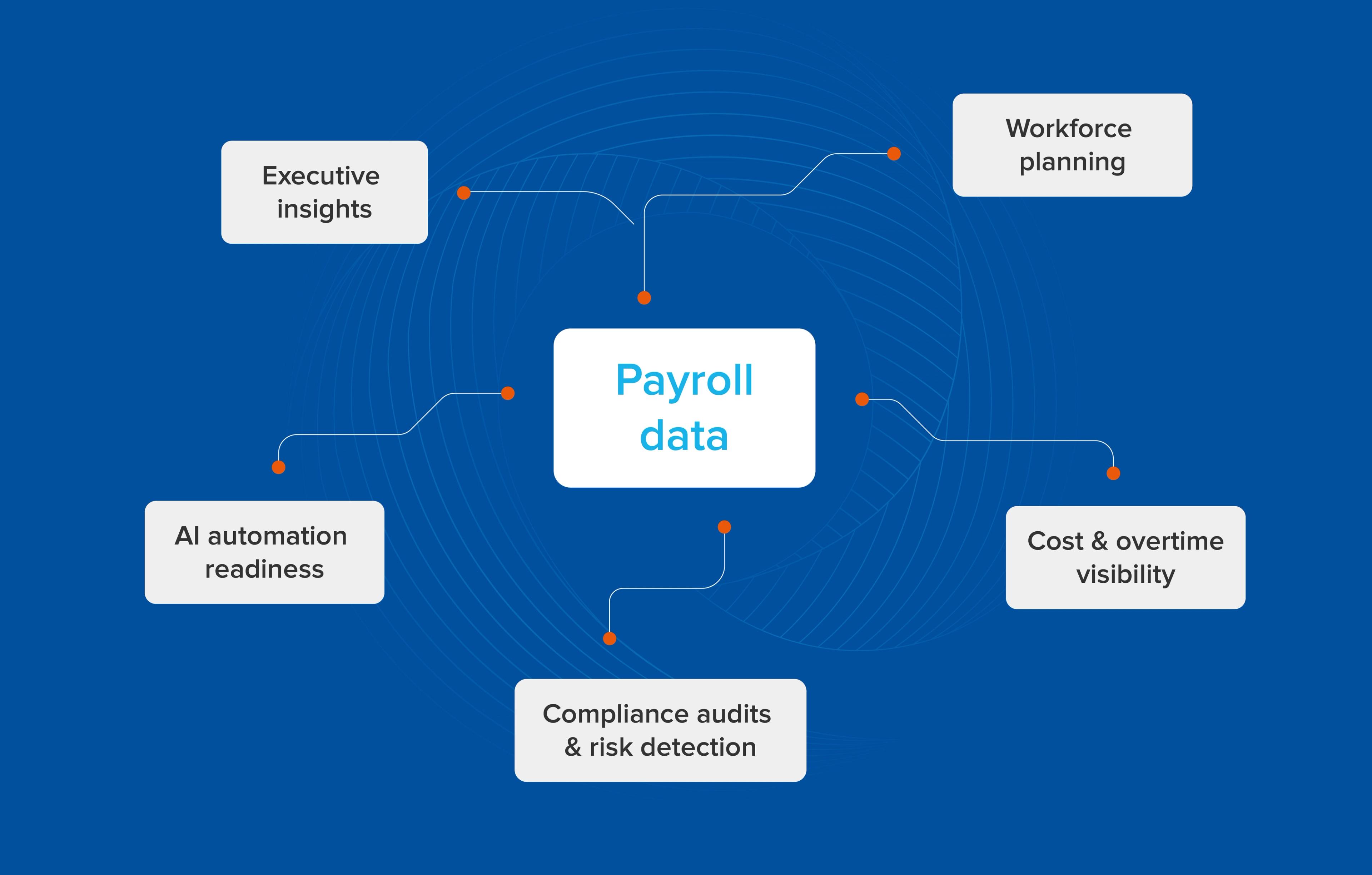
When payroll is connected with Core HR, time and attendance, finance and workforce management, that information can support more than the pay run. It can help organisations:
- Identify workforce cost and overtime trends.
- Detect anomalies and potential compliance risks earlier.
- Improve workforce planning and forecasting.
- Provide executives with more reliable workforce insights.
- Establish a stronger data foundation for automation and AI.
The conversation therefore needs to move beyond:
“Can we run payroll accurately?”
towards:
“Can our payroll data, systems and operating model support where the business is going next?”
What a successful payroll transformation looks like in practice
Becoming strategic does not mean accuracy and timeliness matter less. They remain non-negotiable. A strategic payroll function is built on top of that operational reliability, not instead of it.
Successful payroll transformation projects tend to rest on four foundations:
- Reliable data: Consistent, complete information flowing from Core HR, time and other connected systems, so global payroll data can actually be trusted.
- Strong governance: Clear accountability, controls and visibility over compliance and payroll risk across every market the organisation operates in.
- Connected technology: New systems and standardised processes that reduce manual intervention and support automation, reporting and analytics.
- Organisational capacity: Payroll professionals with the time and skills to interpret data, improve processes and contribute to strategic decision making rather than simply keep the lights on.
Without these foundations in place, payroll teams stay trapped in reactive work: correcting data, resolving exceptions and running manual processes, instead of contributing to the organisation’s general strategy.
Common pitfalls that derail payroll transformation projects
The biggest payroll transformation mistakes are rarely dramatic. They are often decisions that seem reasonable at the time, but create problems further down the line.
Starting with technology instead of the problem: A new platform cannot fix fragmented data, inefficient processes or unclear ownership. Before choosing technology, organisations need to understand what is actually holding payroll back and what they need the new model to achieve.
Underestimating data and process complexity: Payroll transformation often exposes years of inconsistent data, local workarounds and manual processes. Treating data cleansing and process standardisation as implementation tasks rather than transformation priorities can leave organisations with a more expensive version of the same problems.
Focusing on implementation rather than adoption: A transformation is not successful simply because a new system goes live. Payroll teams, HR, finance and other stakeholders need to understand new processes, responsibilities and controls. Without that change management, organisations can quickly recreate old workarounds in new systems.
Assuming one model can work everywhere: Global payroll requires consistency where it creates value, but local expertise where regulations and practices differ. Trying to force every market into the same processes or relying too heavily on a single internal team or provider, can create new compliance and operational risks.
Treating transformation as a one-off project: Payroll does not stop changing when implementation ends. Regulation, technology, workforce structures and employee expectations continue to evolve. Organisations that build continuous improvement into their operating model are better placed to keep payroll efficient, compliant and ready for what comes next.

Unlock efficient global payroll with SAP SuccessFactors
The role of the payroll manager is changing
The skills payroll leaders need are evolving alongside the function itself. Data literacy, oversight of AI and new systems, stakeholder management, and a deep understanding of risk and governance are all becoming core requirements. Payroll managers increasingly need to understand the wider technology ecosystem, explain payroll risk to executives in terms the board understands, and identify where automation and digital transformation can deliver real value rather than just headline efficiency gains.
They are also becoming a connection point between HR, finance, IT and business leadership. The payroll manager’s duties are not about processing more transactions faster anymore. It is about using payroll expertise and data to help the organisation make better decisions.
How Payroll data supports strategic decisions
Becoming strategic should not mean doing more with the same resources
For many payroll teams, this shift towards strategic expectations is happening at a difficult time. Compliance expectations keep rising, technology keeps changing, and organisations keep asking for greater operational efficiency and cost savings while payroll still has to deliver accurate results every single cycle.
That raises a fair question for any organisation: “does your current payroll operating model give the team the capacity to become more strategic, or does it keep everyone focused on getting through the next pay run?”
For some organisations, the right solutions involve strengthening internal capabilities and modernising existing systems. For others, it means reconsidering which activities need to stay in-house and where specialist external support, including third party vendors with deep expertise in payroll solutions, can create more value than trying to build everything internally.
Finding the right model for you with Zalaris Consulting
Getting there doesn't require a single fixed model. Zalaris Consulting works with organisations to assess where their payroll operating model needs to change, whether that means strengthening internal capabilities, modernising existing systems, improving governance, moving to a fully managed model, or a combination of these.
Done well, this brings together specialist payroll expertise, modern technology, governance and automation, backed by the quality assurance and smooth implementation that comes from working with payroll experts who have run these transformation projects before. It also frees up internal payroll and HR leaders to focus on transformation, workforce insight and other strategic initiatives rather than day-to-day processing.
Explore how Zalaris Consulting can help strengthen your payroll operations, governance and capacity, and find the right model for your organisation. Get in touch with our experts today.
FAQ

Joseph Cachapero
Managed Payroll Manager
Joseph Cachapero is a Managed Payroll Manager at Zalaris APAC with over 19 years of experience in payroll operations, managed services, and HR technology across the Asia-Pacific region. He specialises in payroll transformation, service delivery, and operational excellence, helping organisations simplify complexity, ensure compliance, and build efficient payroll processes that support long-term business success.