


The work doesn't end after you choose a payroll service provider. The relationship's success depends on clearly defining each activity, performance measures and escalation processes. Done well, vendor management also creates the evidence you need for audits, compliance reviews and internal assurance.
Key takeaways
- Define responsibilities for inputs, approvals, processing, controls and exceptions.
- Build service-level agreements around payroll outcomes and response times.
- Use governance reviews to link provider performance with continuous improvement.
- Subject material payroll, system and legislative changes to documented controls.
- Include recovery priorities, fallback processes and testing within payroll vendor management.
Start with clear ownership and a governance rhythm
A strong payroll vendor management process starts with operational clarity. This requires two parts:
First, the payroll vendor contract establishes the commercial framework, including costs and service conditions. This is the broad overview, often outlined well before the contract starts.
Second, the organisation and payroll provider agree clear responsibilities, decision rights, service measures and escalation paths so that daily control becomes visible and executable.
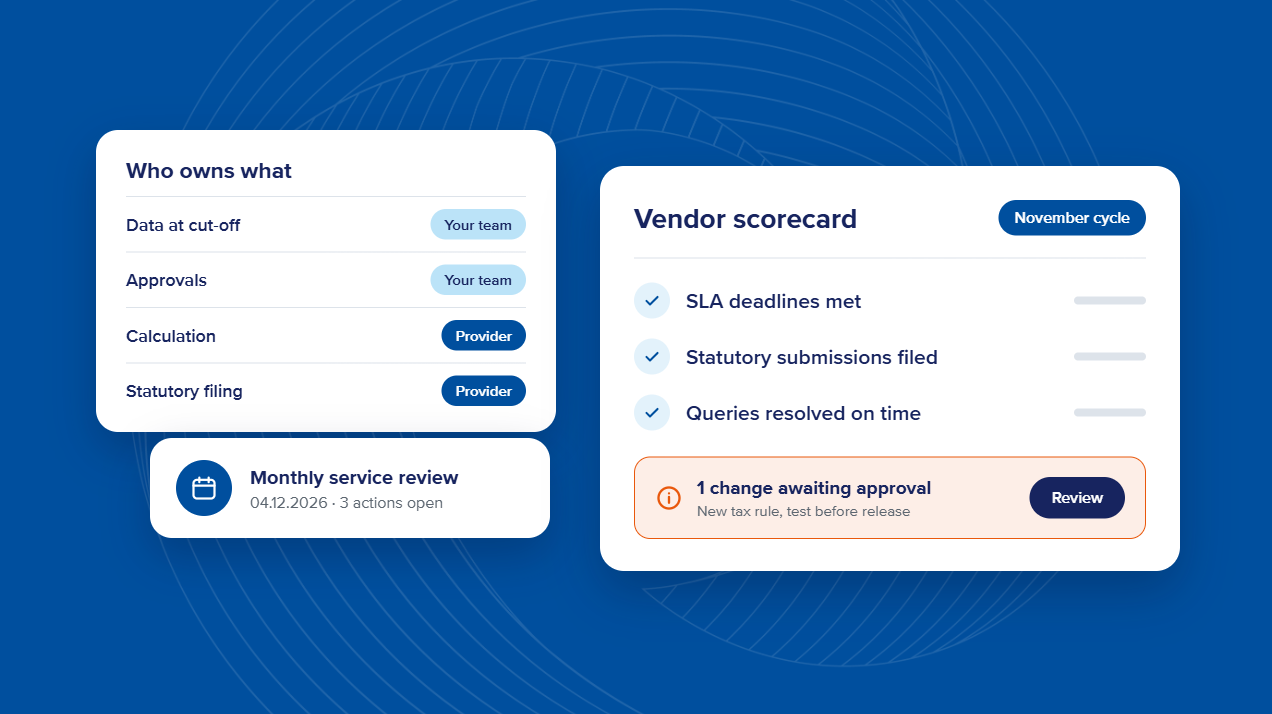
The key to this is a responsibility matrix that includes information on the process and ownership of:
- Employee data
- Variable pay
- Time feeds and calculations
- Validation rules and approvals
- Payment files and statutory submissions
- Payroll queries and reporting
For example, an organisation may own data accuracy at cut-off while the provider owns calculation accuracy after processing. IT may own the HR-to-payroll integration, while the service provider owns monitoring once data enters payroll.
To ensure things are running smoothly, regular governance meetings establish a working rhythm for the organisation and payroll provider. Operational reviews can cover current cycles, incidents and deadlines, while monthly or quarterly reviews can address SLA trends, recurring issues, compliance changes, risks and improvement actions.
Good practice also includes a named owner on both sides, a documented escalation route and a single reliable record of decisions and actions.
Measure the provider on what is under their control
Vendor performance management needs to separate overall payroll results from outcomes the provider controls. Use the responsibility matrix to attribute each result, good or bad, to whoever controlled that step.
Track provider-owned performance
Measure the vendor against service obligations it controls, such as:
- Provider-caused payroll errors: number or percentage of errors linked to calculation, processing or configuration.
- SLA delivery: percentage of agreed activities completed within deadline.
- Incident response: time taken to acknowledge, investigate and resolve provider-owned issues.
- Rework: corrections or off-cycle payments caused by provider error.
- Compliance delivery: statutory submissions completed accurately and on time where the provider owns the task.
Record the target, actual result, cause and owner for each measure every pay cycle. A simple vendor scorecard can provide a consistent way to track performance:
KPI → Target → Actual result → Owner → Status
Turn results into action
Review missed targets and recurring issues. Hold regular service meetings with the provider to review each issue. Each issue needs a root cause, corrective action, named owner and deadline. For example, repeated calculation errors in one pay element may trigger a configuration change and targeted retesting. Track this in a performance improvement log:
Issue → Root cause → Corrective action → Owner → Deadline → Status
Check whether the vendor improves
Track the same measure over subsequent pay cycles, not just the most recent. If performance improves, the improvement action can be closed. However, this doesn't mean that scoring and reporting end. Review performance for as long as the vendor is involved with the payroll. Repeated misses can trigger escalation, a service improvement plan or contractual remedies.
Control payroll changes and compliance
Tax rules, employment legislation, collective agreements, internal policies, integrations and HR systems all affect payroll, and keeping up with them is a recognised burden. The UK Government's Business Perceptions Survey 2024 found that 65% of businesses considered keeping up to date with applicable regulations a burden, while 62% cited completing paperwork and keeping records as a burden.
Payroll vendor management therefore needs one controlled process for assessing, approving and evidencing change. Two linked records make the purpose clear:
| Change control record: manages change | Compliance evidence record: proves the outcome |
|---|---|
| Records what is changing, why it is needed, who approves it and how it will be introduced. | Records evidence that payroll obligations and controls were completed correctly. |
| Examples include a new tax rule, pay-element configuration change, revised integration or payroll calendar change. | Examples include statutory submission confirmations, approval logs, control results, access reviews and resolved compliance exceptions. |
| Captures payroll impact, dependencies, testing, implementation date and rollback plan. | Captures the evidence owner, reporting period, completion status and supporting documentation. |
With these documents, the provider can identify relevant changes and explain operational impact, while the organisation retains visibility over decisions affecting policy, employee communications and internal controls.
Prepare for payroll disruption
Business continuity is part of payroll vendor management because technology outages, cyber incidents, staff unavailability, integration failures and third-party disruptions can affect any payroll cycle. A dedicated payroll business continuity plan[3] defines how the organisation and provider protect critical payroll activities, make decisions and recover when normal processing is interrupted.
In practice, payroll continuity planning requires the following steps:
- Agree critical activities, recovery priorities, decision-makers, emergency contacts and fallback processes before disruption occurs.
- Cover payroll data access, payment file production and approval, statutory deadlines and employee communications.
- Include visibility beyond the primary provider, including critical subcontractors, hosting services and banking connections.
- Run recovery tests to confirm that responsibilities, backup data, alternative approvals and communication routes work in practice.
The payroll disaster recovery plan can then document the technical and operational steps required to restore payroll services, with any gaps identified during testing recorded and addressed.
Payroll vendor management checklist
A concise checklist turns the practices above into consistent actions across pay cycles and service reviews.
- Responsibilities: Is ownershipfor inputs, calculations, approvals, payments, compliance and technology clearly defined and documented?
- Governance and compliance: Are meeting cadences, attendees, decisions and action owners defined, with evidence retained for submissions, controls, access and legislative updates?
- SLAs: Are accuracy, timeliness, responsiveness and compliance delivery measured against agreed targets?
- Performance and escalation: Does payroll data reveal recurring issues, and are severity levels, response expectations and decision rights clearly defined?
- Change control and continuity: Are impact assessments, testing, approvals, release dates, recovery priorities and fallback processes documented?
- Review: Is the payroll vendor management process refreshed when scope, systems, countries or risk exposure change, supported by a regular audit of your outsourced payroll contract?
Keep control without taking the work back
Effective payroll vendor management keeps an outsourced payroll service controlled, accountable and aligned with business requirements. Clear ownership and governance frameworks ensure escalations and payroll changes follow defined processes with clear accountability. This keeps payroll firmly under the organisation’s control without adding back the workload outsourcing was meant to solve.
That same balance between external delivery and internal control is central to Zalaris' managed payroll services. Zalaris combines payroll technology and specialist expertise with structured governance, service management and reporting. Our professional payroll teams help organisations maintain visibility over performance, compliance and accountability.
Contact Zalaris before the next change interrupts your payroll.