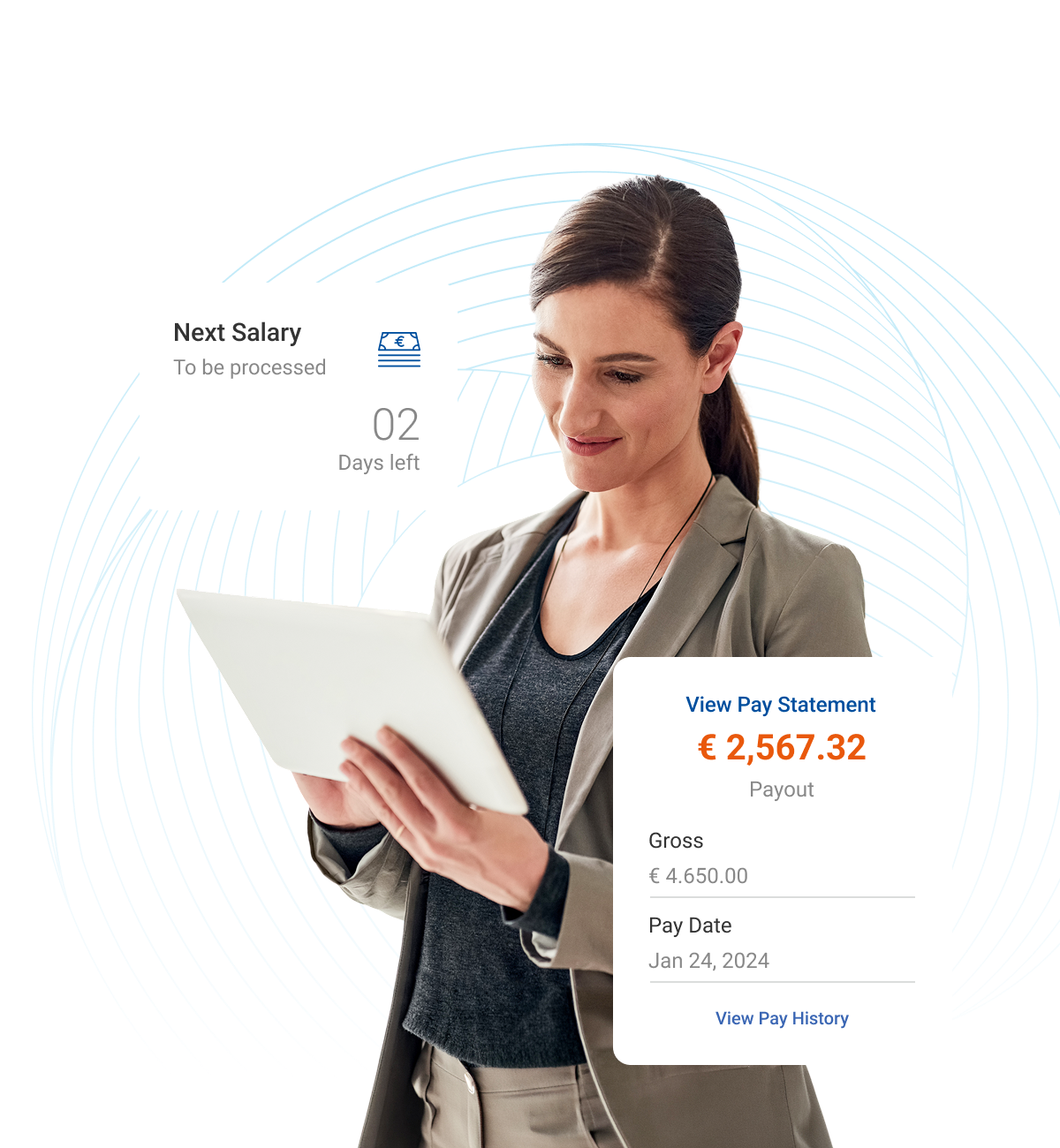

One partner instead of several interfaces
Software, operations and consulting work together. When something goes wrong in a payroll run, you call one team and not three suppliers.
Payroll outsourcing means handing the calculation, payment and filing of employee pay to an external provider that runs the process to agreed service levels. Your organisation stays the employer and stays accountable for the data and for decisions about pay. This guide covers the four decisions that matter: whether to outsource at all, which provider to choose, how pricing works and what the contract must say.
Outsourcing payroll comes down to four decisions, taken in this order: whether to keep payroll in-house, which provider to choose, how the pricing works and what the contract must say. Payroll outsourcing services range from a hosted platform to a fully managed service, and the sections below take each decision in turn.
Payroll outsourcing is an arrangement in which an external provider runs part or all of an organisation's payroll: collecting inputs, calculating gross to net pay, paying employees, filing with tax and social security authorities and producing reports. A service agreement binds the provider. The organisation remains the employer and stays accountable for the result.
The market uses several labels for the same thing. Payroll outsourcing services, managed payroll and payroll as a service all describe a provider-run process. Payroll software on its own does not qualify. If your team still runs the process, you have bought a tool, not outsourced the work.
→ Learn more: managed payroll services
Scope varies more than the label suggests. Providers sell anything from a hosted payroll platform that your team still operates to a fully managed service where you only approve the results. Agree which level you are buying before you compare prices, because quotes for different levels are not comparable.
| Level | What the provider takes on | What stays with you |
|---|---|---|
| 1 Cloud platform | Hosts and maintains the payroll software and applies statutory updates | Running payroll, validation and filings |
| 2 Payroll processing | Calculates payroll, produces payslips and payment files, prepares filings | Supplying and validating inputs, approving results |
| 3 Fully managed payroll | Runs the process end to end: chasing inputs, validation, payment instructions, filings and employee payroll queries | Approving results, pay decisions, keeping employment data correct at source |
| 4 Payroll with HR administration | Adds master data, absence, onboarding and an employee helpdesk | Policy, strategy and employee relations |
Our pages on payroll processing and complete HR and payroll outsourcing describe how Zalaris delivers levels 2 to 4. For the wider question of which HR processes to hand over alongside payroll, see our guide to HR outsourcing and the article on multi-process HR outsourcing.
The make-or-buy question is rarely about cost alone. Most organisations begin looking at outsourcing after a specific failure rather than a strategy review. A payroll specialist leaves and nobody can cover the run. A legislative change catches the team out. An acquisition adds payroll in new countries or on another system. If one of these sounds familiar, the case for buying is stronger than the spreadsheet suggests.
In-house payroll still makes sense for stable, single-country organisations with a deep team and little change. For everyone else there is a middle route. Hybrid models split the work, for example by keeping calculation in-house while a provider handles filings and statutory updates, or by outsourcing only the countries where you lack local expertise. Our comparison In-house, hybrid or managed goes into the trade-offs.
A quick test: if payroll accuracy depends on one or two people, you are carrying a risk that a provider spreads across a whole team.
Payroll operating models compared
Who runs payroll, how much effort stays inside and how each model copes with change, compared side by side.
Payroll outsourcing removes routine work and keeps compliance current, but it moves control to a contract. Each benefit below has a matching risk, and each risk has a contractual or operational answer.
| Benefit | Risk | How to reduce it |
|---|---|---|
| Less routine work for HR and finance | Less direct control over the process | Defined service levels, reporting and named contacts |
| Provider keeps up with legislation | Dependence on a single provider | Exit terms, data return and documented processes |
| More predictable cost | Charges for changes after signing | A clear service catalogue and a rate card for extras |
| Cover for absence and peak periods | Transition risk at go-live | Structured transition and a parallel run |
| Access to current technology | Exposure of sensitive employee data | Data processing agreement, access controls and certifications |
Choose a payroll outsourcing provider by comparing eight things: references, compliance coverage, data protection, technology fit, service levels, pricing, transition approach and exit terms. Agree the weighting before you issue a request for proposal, not after you have seen the demonstrations.
Ask each shortlisted provider what went wrong in a client's first year and how they fixed it. The answer tells you more than the brochure. Our buyer's guide to choosing a payroll provider walks through the selection process, and the RFI and RFP template makes proposals easier to compare. The webinar Outsourcing payroll: learning from mistakes covers the pitfalls.
Providers usually charge a monthly fee per employee or a fee per payroll run, often with a minimum for small populations. Expect one-off charges for analysis, data migration and implementation. Some quote one bundled price and others itemise everything. Neither is better, provided you can compare like with like.
Typical cost drivers
Where extra costs tend to appear
When you compare outsourcing with in-house payroll, count the full cost of keeping it: salaries and cover for absence, software licences and upgrades, training, audit and compliance effort, and the cost of correcting errors. Set that against the provider's total over the contract term, including transition and the changes you expect to make. The article on the cost and efficiency potential of payroll outsourcing covers the benefit side.
The contract decides what the provider is accountable for. Whether you are about to sign or approaching renewal, review the points below. Most of the risk you think you have transferred sits in the clauses on liability, change control and exit.
| Area | What to check | Red flag |
|---|---|---|
| Scope | A written service catalogue that names every task | Tasks described as 'standard payroll' without detail |
| Service levels | Deadlines, accuracy targets, query response times and what happens when a target is missed | Targets with no remedy |
| Liability | Who pays penalties and interest caused by provider errors, and any cap on liability | A cap far below the cost of a failed payroll run |
| Change control | A rate card for extra services and a defined change process | Open-ended 'time and materials' for changes |
| Pricing | Indexation, minimum volumes and charges for adding countries or employees | Automatic annual increases with no ceiling |
| Data protection | Data processing agreement, sub-processors, processing locations and breach notification | Sub-processors that can change without notice |
| Audit and assurance | Your right to audit, plus independent assurance reports | No audit right |
| Exit | Notice period, data return format, transition support and its cost | Data returned only on request and at extra charge |
Our checklist to audit your payroll outsourcing contract for hidden risks and costs turns these points into a working document.
→ Learn more: contract audit checklist
The employer remains responsible for employee data when payroll is outsourced. Where GDPR applies, Article 28 requires a written data processing agreement covering purpose, instructions, security measures and sub-processors. Outside GDPR jurisdictions, equivalent local rules apply. If payroll data leaves a country or region, check that a lawful transfer mechanism is in place. Ask providers for independent assurance, such as ISAE 3402 or SOC 1 reports and ISO 27001 certification. Our article on outsourcing and data protection covers the requirements in more detail.
Employment law needs an early check too. If employees or assets move to the provider along with the process, transfer-of-undertaking rules may apply. These come from the EU Acquired Rights Directive as implemented in each member state, and from TUPE in the UK. A service agreement under which no employees or assets transfer generally does not trigger them, but the outcome depends on the facts. Where the law requires consultation with employee representatives, such as works councils, start it early. Take local legal advice before you commit.
This content is for general information only and does not constitute legal or tax advice.
A transition normally runs through six steps: analysis of processes and data, a plan with named responsibilities, data migration, testing, a parallel run and go-live with close monitoring. The parallel run, in which old and new set-ups process the same payroll and the results are compared, is the main safeguard.
Outsourcing projects tend to stumble on the same problems. The service scope is unclear, source data is poor, nobody inside the organisation owns the work and the schedule leaves too little time for the parallel run. Fix those four and most delays disappear. Zalaris supports the handover through dedicated Transition Management.
Multi-country payroll adds local compliance, language and currency. It also adds a structural choice: one provider with its own in-country delivery, a network of local providers coordinated by an aggregator, or a mix. Those operating-model questions are covered in our Global payroll guide.
The criteria on this page apply in every case. Ask each provider to show how it delivers and takes responsibility for each country you need, and not merely where it has a partner. Our global HR and payroll services page lists the countries and service range. If you want to enter a market without setting up a legal entity, an Employer of Record is the usual route.
Payroll rules, filing deadlines and provider markets differ by country. Where we have a country guide, it builds on this page.




Zalaris runs payroll as a fully managed service, or takes on defined parts of it while your team keeps the rest. Technology, operations and transformation come from one partner, so responsibility and quality sit with a single point of contact.
Software, operations and consulting work together. When something goes wrong in a payroll run, you call one team and not three suppliers.
Start with a single country or process and add more without changing provider. Zalaris has processed payroll in more than 150 countries over 25 years, with local compliance expertise behind each.
The move into outsourced operations is the riskiest moment. Zalaris plans it through dedicated Transition Management, with a parallel run before go-live.
Hand over payroll entirely, or keep calculation in-house while Zalaris handles filings, statutory updates or specific countries. The model can change as your needs do.
From a single payroll process to a fully managed service across countries, Zalaris offers a model that fits your organisation and can change as your needs do.
Payroll requirements differ by sector. The pay rules behind a shift-based factory, a seasonal retailer and a regulated laboratory have little in common.

Shift allowances, overtime and collective agreements across several sites.


Decentralised workforces and project-based assignments.

Part-time, full-time and seasonal contracts with high turnover.
For more than 25 years, Zalaris has run payroll for organisations that need accuracy, compliance and a service team they can name. Customers get technology, specialist knowledge and a dedicated team under one contract.
Countries with local compliance expertise
Years of payroll and HR experience

Innomotics is transforming its global HR function in partnership with Zalaris.
Our payroll services are recognised by industry analysts and award programmes. Read how Zalaris was named a Leader in NelsonHall's Reimagining Payroll Services NEAT 2026.









Speak to our payroll experts to find the model that fits your organisation, from a single process to a fully managed payroll across countries.